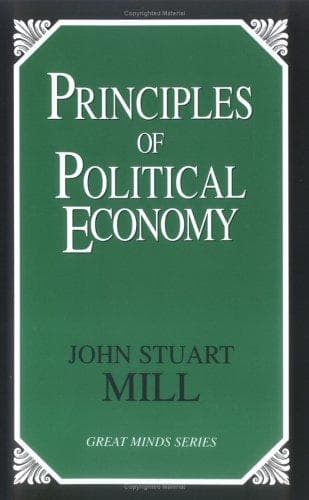
Principles of Political Economy: Abridged with Critical, Bibliographical, and Explanatory Notes, and a Sketch of the History of Political Economy — John Shaqi
Principles of Political Economy: Abridged with Critical, Bibliographical, and Explanatory Notes, and a Sketch of the History of Political EconomyMill, John Stuart
PhilosophyPhilosophy
Principles of Political Economy: Abridged with Critical, Bibliographical, and Explanatory Notes, and a Sketch of the History of Political Economy
Mill, John Stuart
Economics
not include Wages of Superintendence.
§ 2. The Minimum of Profits; what produces Variations in the Amount
of Profits.
§ 3. General Tendency of Profits to an Equality.
§ 4. The Cause of the Existence of any Profit; the Advances of
Capitalists consist of Wages of Labor.
§ 5. The Rate of Profit depends on the Cost of Labor.
Chapter VI. Of Rent.
§ 1. Rent the Effect of a Natural Monopoly.
§ 2. No Land can pay Rent except Land of such Quality or Situation
as exists in less Quantity than the Demand.
§ 3. The Rent of Land is the Excess of its Return above the Return
to the worst Land in Cultivation.
§ 4. —Or to the Capital employed in the least advantageous
Circumstances.
§ 5. Opposing Views of the Law of Rent.
§ 6. Rent does not enter into the Cost of Production of Agricultural
Produce.
Book III. Exchange.
Chapter I. Of Value.
§ 1. Definitions of Value in Use, Exchange Value, and Price.
§ 2. Conditions of Value: Utility, Difficulty of Attainment, and
Transferableness.
§ 3. Commodities limited in Quantity by the law of Demand and
Supply: General working of this Law.
§ 4. Miscellaneous Cases falling under this Law.
§ 5. Commodities which are Susceptible of Indefinite Multiplication
without Increase of Cost. Law of their Value Cost of Production.
§ 6. The Value of these Commodities confirm, in the long run, to
their Cost of Production through the operation of Demand and Supply.
Chapter II. Ultimate Analysis Of Cost Of Production.
§ 1. Of Labor, the principal Element in Cost of Production.
§ 2. Wages affect Values, only if different in different
employments; “non-competing groups.”
§ 3. Profits an element in Cost of Production.
§ 4. Cost of Production properly represented by sacrifice, or cost,
to the Laborer as well as to the Capitalist; the relation of this
conception to the Cost of Labor.
§ 5. When profits vary from Employment to Employment, or are spread
over unequal lengths of Time, they affect Values accordingly.
§ 6. Occasional Elements in Cost of Production; taxes and
ground-rent.
Chapter III. Of Rent, In Its Relation To Value.
§ 1. Commodities which are susceptible of indefinite Multiplication,
but not without increase of Cost. Law of their Value, Cost of
Production in the most unfavorable existing circumstances.
§ 2. Such commodities, when Produced in circumstances more
favorable, yield a Rent equal to the difference of Cost.
§ 3. Rent of Mines and Fisheries and ground-rent of Buildings, and
cases of gain analogous to Rent.
§ 4. _Résumé_ of the laws of value of each of the three classes of
commodities.
Chapter IV. Of Money.
§ 1. The three functions of Money—a Common Denominator of Value, a
Medium of Exchange, a “Standard of Value”.
§ 2.
Public-domain text, read in full here on John Shaqi.
Reviews
Reviews
No reviews yet
Be the first to share your thoughts on this work.
Join the Discussion
Join the discussion
Sign in to leave a comment or review.
Sign InorCreate an account