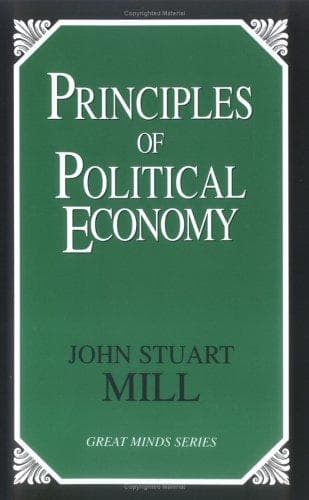
Principles of Political Economy: Abridged with Critical, Bibliographical, and Explanatory Notes, and a Sketch of the History of Political EconomyMill, John Stuart
PhilosophyPhilosophy
Principles of Political Economy: Abridged with Critical, Bibliographical, and Explanatory Notes, and a Sketch of the History of Political Economy
Mill, John Stuart
Economics
Gold and Silver, why fitted for those purposes.
§ 3. Money a mere contrivance for facilitating exchanges, which does
not affect the laws of value.
Chapter V. Of The Value Of Money, As Dependent On Demand And Supply.
§ 1. Value of Money, an ambiguous expression.
§ 2. The Value of Money depends on its quantity.
§ 3. —Together with the Rapidity of Circulation.
§ 4. Explanations and Limitations of this Principle.
Chapter VI. Of The Value Of Money, As Dependent On Cost Of Production.
§ 1. The value of Money, in a state of Freedom, conforms to the
value of the Bullion contained in it.
§ 2. —Which is determined by the cost of production.
§ 3. This law, how related to the principle laid down in the
preceding chapter.
Chapter VII. Of A Double Standard And Subsidiary Coins.
§ 1. Objections to a Double Standard.
§ 2. The use of the two metals as money, and the management of
Subsidiary Coins.
§ 3. The experience of the United States with a double standard from
1792 to 1883.
Chapter VIII. Of Credit, As A Substitute For Money.
§ 1. Credit not a creation but a Transfer of the means of
Production.
§ 2. In what manner it assists Production.
§ 3. Function of Credit in economizing the use of Money.
§ 4. Bills of Exchange.
§ 5. Promissory Notes.
§ 6. Deposits and Checks.
Chapter IX. Influence Of Credit On Prices.
§ 1. What acts on prices is Credit, in whatever shape given.
§ 2. Credit a purchasing Power, similar to Money.
§ 3. Great extensions and contractions of Credit. Phenomena of a
commercial crisis analyzed.
§ 4. Influence of the different forms of Credit on Prices.
§ 5. On what the use of Credit depends.
§ 6. What is essential to the idea of Money?
Chapter X. Of An Inconvertible Paper Currency.
§ 1. What determines the value of an inconvertible paper money?
§ 2. If regulated by the price of Bullion, as inconvertible Currency
might be safe, but not Expedient.
§ 3. Examination of the doctrine that an inconvertible Current is
safe, if representing actual Property.
§ 4. Experiments with paper Money in the United States.
§ 5. Examination of the gain arising from the increase and issue of
paper Currency.
§ 6. _Résumé_ of the subject of money.
Chapter XI. Of Excess Of Supply.
§ 1. The theory of a general Over-Supply of Commodities stated.
§ 2. The supply of commodities in general can not exceed the power
of Purchase.
§ 3. There can never be a lack of Demand arising from lack of Desire
to Consume.
§ 4. Origin and Explanation of the notion of general Over-Supply.
Chapter XII. Of Some Peculiar Cases Of Value.
§ 1. Values of commodities which have a joint cost of production.
§ 2. Values of the different kinds of agricultural produce.
Chapter XIII.
Public-domain text, read in full here on John Shaqi.
Reviews
Reviews
No reviews yet
Be the first to share your thoughts on this work.
Join the Discussion
Join the discussion
Sign in to leave a comment or review.
Sign InorCreate an account