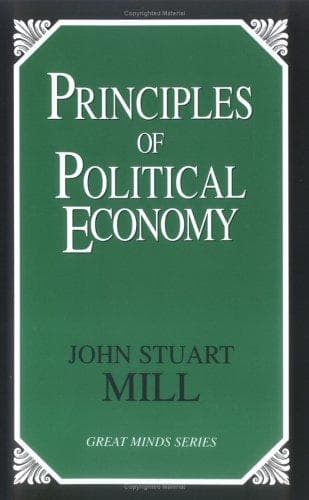
Principles of Political Economy: Abridged with Critical, Bibliographical, and Explanatory Notes, and a Sketch of the History of Political EconomyMill, John Stuart
PhilosophyPhilosophy
Principles of Political Economy: Abridged with Critical, Bibliographical, and Explanatory Notes, and a Sketch of the History of Political Economy
Mill, John Stuart
Economics
This is the usual definition of wealth. Henry George (see
“Progress and Poverty,” pp. 34-37) regards wealth as consisting
“of natural products that have been secured, moved, combined,
separated, or in other ways _modified by human exertion_, so as to
fit them for the gratification of human desires.... Nothing which
Nature supplies to man without his labor is wealth.... All things
which have an exchange value are, therefore, not wealth. Only such
things can be wealth the production of which increases and the
destruction of which decreases the aggregate of wealth....
Increase in land values does not represent increase in the common
wealth, for what land-owners gain by higher prices the tenants or
purchasers who must pay them will lose.” Jevons (“Primer,” p. 13)
defines wealth very properly as what is transferable, limited in
supply, and useful. F. A. Walker defines wealth as comprising “all
articles of value and nothing else” (“Political Economy,” p. 5).
Levasseur’s definition (“Précis,” p. 15) is, “all material objects
possessing utility” (i.e., the power to satisfy a want). (Cf.
various definitions in Roscher’s “Political Economy,” section 9,
note 3.) Perry (“Political Economy,” p. 99) rejects the term
_wealth_ as a clog to progress in the science, and adopts
_property_ in its stead, defining it as that “which can be bought
or sold.” Cherbuliez (“Précis,” p. 70) defines wealth as the
material product of nature appropriated by labor for the wants of
man. Carey (“Social Science,” i, 186) asserts that wealth consists
in the power to command Nature’s services, including in wealth
such intangible things as mental qualities.
BOOK I. PRODUCTION.
Chapter I. Of The Requisites Of Production.
§ 1. The Requisites of Production are Two: Labor, and Appropriate Natural
Objects.
There is a third requisite of production, capital (see page 58).
Since the limitation to only two requisites applies solely to a
primitive condition of existence, so soon as the element of _time_
enters into production, then a store of capital becomes necessary;
that is, so soon as production requires such a term that during
the operation the laborer can not at the same time provide himself
with subsistence, then capital is a requisite of production. This
takes place also under any general division of labor in a
community. When one man is making a pin-head, he must be supplied
with food by some person until the pins are finished and
exchanged.
Labor is either bodily or mental; or, to express the distinction more
comprehensively, either muscular or nervous; and it is necessary to
include in the idea, not solely the exertion itself, but all feelings of a
disagreeable kind, all bodily inconvenience or mental annoyance, connected
with the employment of one’s thoughts, or muscles, or both, in a
particular occupation.
Public-domain text, read in full here on John Shaqi.
Reviews
Reviews
No reviews yet
Be the first to share your thoughts on this work.
Join the Discussion
Join the discussion
Sign in to leave a comment or review.
Sign InorCreate an account