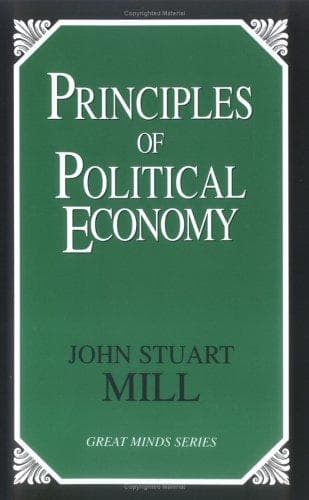
Principles of Political Economy: Abridged with Critical, Bibliographical, and Explanatory Notes, and a Sketch of the History of Political EconomyMill, John Stuart
PhilosophyPhilosophy
Principles of Political Economy: Abridged with Critical, Bibliographical, and Explanatory Notes, and a Sketch of the History of Political Economy
Mill, John Stuart
Economics
The word “sacrifice” conveys a just idea of what the laborer
undergoes, and it corresponds to the abstinence of the capitalist.
Of the other requisite—appropriate natural objects—it is to be remarked
that some objects exist or grow up spontaneously, of a kind suited to the
supply of human wants. There are caves and hollow trees capable of
affording shelter; fruits, roots, wild honey, and other natural products,
on which human life can be supported; but even here a considerable
quantity of labor is generally required, not for the purpose of creating,
but of finding and appropriating them.
Of natural powers, some are unlimited, others limited in quantity. By an
unlimited quantity is of course not meant literally, but practically
unlimited: a quantity beyond the use which can in any, or at least in
present circumstances, be made of it. Land is, in some newly settled
countries, practically unlimited in quantity: there is more than can be
used by the existing population of the country, or by any accession likely
to be made to it for generations to come. But, even there, land favorably
situated with regard to markets, or means of carriage, is generally
limited in quantity: there is not so much of it as persons would gladly
occupy and cultivate, or otherwise turn to use. In all old countries, land
capable of cultivation, land at least of any tolerable fertility, must be
ranked among agents limited in quantity. Coal, metallic ores, and other
useful substances found in the earth, are still more limited than land.
For the present I shall only remark that, so long as the quantity of a
natural agent is practically unlimited, it can not, unless susceptible of
artificial monopoly, bear any value in the market, since no one will give
anything for what can be obtained gratis. But as soon as a limitation
becomes practically operative—as soon as there is not so much of the thing
to be had as would be appropriated and used if it could be obtained for
asking—the ownership or use of the natural agent acquires an exchangeable
value.
Rich lands in our Western Territories a few years ago could be had
practically for the asking; but now, since railways and an
increase of population have brought them nearer to the markets,
they have acquired a distinct exchange value. The value of a
commodity (it may be anticipated) is the quantity of other things
for which it can be exchanged.
When more water-power is wanted in a particular district than there are
falls of water to supply it, persons will give an equivalent for the use
of a fall of water. When there is more land wanted for cultivation than a
place possesses, or than it possesses of a certain quality and certain
advantages of situation, land of that quality and situation may be sold
for a price, or let for an annual rent.
§ 2. The Second Requisite of Production, Labor.
Public-domain text, read in full here on John Shaqi.
Reviews
Reviews
No reviews yet
Be the first to share your thoughts on this work.
Join the Discussion
Join the discussion
Sign in to leave a comment or review.
Sign InorCreate an account