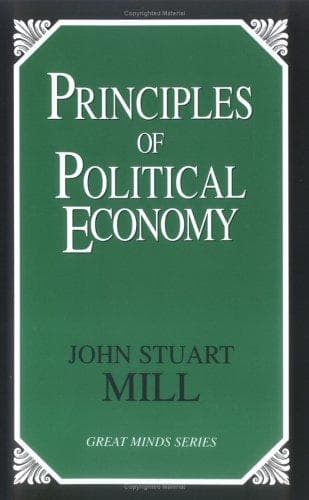
Principles of Political Economy: Abridged with Critical, Bibliographical, and Explanatory Notes, and a Sketch of the History of Political Economy — John Shaqi
Principles of Political Economy: Abridged with Critical, Bibliographical, and Explanatory Notes, and a Sketch of the History of Political EconomyMill, John Stuart
PhilosophyPhilosophy
Principles of Political Economy: Abridged with Critical, Bibliographical, and Explanatory Notes, and a Sketch of the History of Political Economy
Mill, John Stuart
Economics
The previous employment of labor is an indispensable condition to every
productive operation, on any other than the very smallest scale. Except
the labor of the hunter and fisher, there is scarcely any kind of labor to
which the returns are immediate. Productive operations require to be
continued a certain time before their fruits are obtained. Unless the
laborer, before commencing his work, possesses a store of food, or can
obtain access to the stores of some one else, in sufficient quantity to
maintain him until the production is completed, he can undertake no labor
but such as can be carried on at odd intervals, concurrently with the
pursuit of his subsistence.
The possession of capital is thus a third requisite of production,
together with land and labor, as noted above. Henry George
(“Progress and Poverty,” chap. iv) holds an opposite opinion: “The
subsistence of the laborers who built the Pyramids was drawn, not
from a previously hoarded stock” (does he not forget the story of
Joseph’s store of corn?), “but from the constantly recurring crops
of the Nile Valley.”
He can not obtain food itself in any abundance; for every mode of so
obtaining it requires that there be already food in store. Agriculture
only brings forth food after the lapse of months; and, though the labors
of the agriculturist are not necessarily continuous during the whole
period, they must occupy a considerable part of it. Not only is
agriculture impossible without food produced in advance, but there must be
a very great quantity in advance to enable any considerable community to
support itself wholly by agriculture. A country like England or the United
States is only able to carry on the agriculture of the present year
because that of past years has provided, in those countries or somewhere
else, sufficient food to support their agricultural population until the
next harvest. They are only enabled to produce so many other things
besides food, because the food which was in store at the close of the last
harvest suffices to maintain not only the agricultural laborers, but a
large industrious population besides.
Public-domain text, read in full here on John Shaqi.
Reviews
Reviews
No reviews yet
Be the first to share your thoughts on this work.
Join the Discussion
Join the discussion
Sign in to leave a comment or review.
Sign InorCreate an account