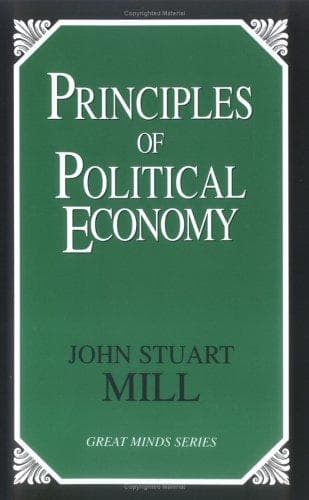
Principles of Political Economy: Abridged with Critical, Bibliographical, and Explanatory Notes, and a Sketch of the History of Political Economy — John Shaqi
Principles of Political Economy: Abridged with Critical, Bibliographical, and Explanatory Notes, and a Sketch of the History of Political EconomyMill, John Stuart
PhilosophyPhilosophy
Principles of Political Economy: Abridged with Critical, Bibliographical, and Explanatory Notes, and a Sketch of the History of Political Economy
Mill, John Stuart
Economics
The claim to remuneration founded on the possession of food, available for
the maintenance of laborers, is of another kind; remuneration for
abstinence, not for labor. If a person has a store of food, he has it in
his power to consume it himself in idleness, or in feeding others to
attend on him, or to fight for him, or to sing or dance for him. If,
instead of these things, he gives it to productive laborers to support
them during their work, he can, and naturally will, claim a remuneration
from the produce. He will not be content with simple repayment; if he
receives merely that, he is only in the same situation as at first, and
has derived no advantage from delaying to apply his savings to his own
benefit or pleasure. He will look for some equivalent for this
forbearance:(103) he will expect his advance of food to come back to him
with an increase, called, in the language of business, a profit; and the
hope of this profit will generally have been a part of the inducement
which made him accumulate a stock, by economizing in his own consumption;
or, at any rate, which made him forego the application of it, when
accumulated, to his personal ease or satisfaction.
Chapter II. Of Unproductive Labor.
§ 1. Definition of Productive and Unproductive Labor.
Labor is indispensable to production, but has not always production for
its effect. There is much labor, and of a high order of usefulness, of
which production is not the object. Labor has accordingly been
distinguished into Productive and Unproductive. Productive labor means
labor productive of wealth. We are recalled, therefore, to the question
touched upon in our [Preliminary Remarks], what Wealth is.
By Unproductive Labor, on the contrary, will be understood labor which
does not terminate in the creation of material wealth. And all labor,
according to our present definition, must be classed as unproductive,
which terminates in a permanent benefit, however important, provided that
an increase of material products forms no part of that benefit. The labor
of saving a friend’s life is not productive, unless the friend is a
productive laborer, and produces more than he consumes.
Public-domain text, read in full here on John Shaqi.
Reviews
Reviews
No reviews yet
Be the first to share your thoughts on this work.
Join the Discussion
Join the discussion
Sign in to leave a comment or review.
Sign InorCreate an account