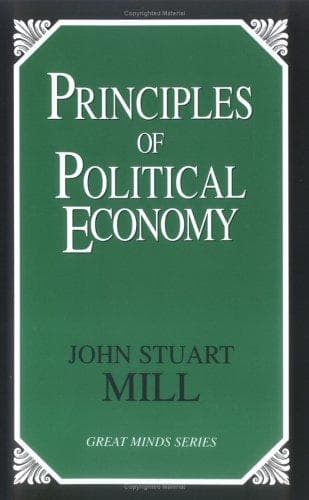
Principles of Political Economy: Abridged with Critical, Bibliographical, and Explanatory Notes, and a Sketch of the History of Political EconomyMill, John Stuart
PhilosophyPhilosophy
Principles of Political Economy: Abridged with Critical, Bibliographical, and Explanatory Notes, and a Sketch of the History of Political Economy
Mill, John Stuart
Economics
Of International Trade.
§ 1. Cost of Production not a regulator of international values.
Extension of the word “international.”
§ 2. Interchange of commodities between distance places determined
by differences not in their absolute, but in the comparative, costs
of production.
§ 3. The direct benefits of commerce consist in increased Efficiency
of the productive powers of the World.
§ 4. —Not in a Vent for exports, nor in the gains of Merchants.
§ 5. Indirect benefits of Commerce, Economical and Moral; still
greater than the Direct.
Chapter XIV. Of International Values.
§ 1. The values of imported commodities depend on the Terms of
international interchange.
§ 2. The values of foreign commodities depend, not upon Cost of
Production, but upon Reciprocal Demand and Supply.
§ 3. —As illustrated by trade in cloth and linen between England and
Germany.
§ 4. The conclusion states in the Equation of International Demand.
§ 5. The cost to a country of its imports depends not only on the
ratio of exchange, but on the efficiency of its labor.
Chapter XV. Of Money Considered As An Imported Commodity.
§ 1. Money imported on two modes; as a Commodity, and as a medium of
Exchange.
§ 2. As a commodity, it obeys the same laws of Value as other
imported Commodities.
Chapter XVI. Of The Foreign Exchanges.
§ 1. Money passes from country to country as a Medium of Exchange,
through the Exchanges.
§ 2. Distinction between Variations in the Exchanges which are
self-adjusting and those which can only be rectified through Prices.
Chapter XVII. Of The Distribution Of The Precious Metals Through The
Commercial World.
§ 1. The substitution of money for barter makes no difference in
exports and imports, nor in the Law of international Values.
§ 2. The preceding Theorem further illustrated.
§ 3. The precious metals, as money, are of the same Value, and
distribute themselves according to the same Law, with the precious
metals as a Commodity.
§ 4. International payments entering into the “financial account.”
Chapter XVIII. Influence Of The Currency On The Exchanges And On
Foreign Trade.
§ 1. Variations in the exchange, which originate in the Currency.
§ 2. Effect of a sudden increase of a metallic Currency, or of the
sudden creation of Bank-Notes or other substitutes for Money.
§ 3. Effect of the increase of an inconvertible paper Currency. Real
and nominal exchange.
Chapter XIX. Of The Rate Of Interest.
§ 1. The Rate of Interest depends on the Demand and Supply of Loans.
§ 2. Circumstances which Determine the Permanent Demand and Supply
of Loans.
§ 3. Circumstances which Determine the Fluctuations.
§ 4. The Rate of Interest not really Connected with the value of
Public-domain text, read in full here on John Shaqi.
Reviews
Reviews
No reviews yet
Be the first to share your thoughts on this work.
Join the Discussion
Join the discussion
Sign in to leave a comment or review.
Sign InorCreate an account