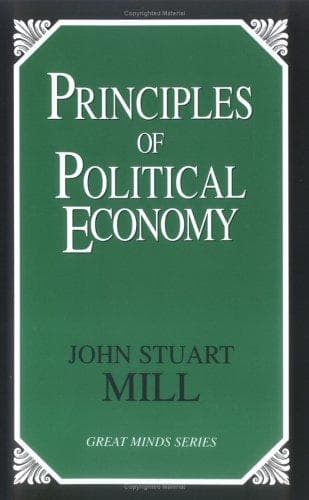
Principles of Political Economy: Abridged with Critical, Bibliographical, and Explanatory Notes, and a Sketch of the History of Political EconomyMill, John Stuart
PhilosophyPhilosophy
Principles of Political Economy: Abridged with Critical, Bibliographical, and Explanatory Notes, and a Sketch of the History of Political Economy
Mill, John Stuart
Economics
Wherever it has seemed possible, American illustrations have been inserted
instead of English or Continental ones.
To interest the reader in home problems, twenty-four charts have been
scattered throughout the volume, which bear upon our own conditions, with
the expectation, also, that the different methods of graphic
representation here presented would lead students to apply them to other
questions. They are mainly such as I have employed in my class-room. The
use and preparation of such charts ought to be encouraged. The earlier
pages of the volume have been given up to a “Sketch of the History of
Political Economy,” which aims to give the story of how we have arrived at
our present knowledge of economic laws. The student who has completed Mill
will then have a very considerable bibliography of the various schools and
writers from which to select further reading, and to select this reading
so that it may not fall wholly within the range of one class of writers.
But, for the time that Mill is being first studied, I have added a list of
the most important books for consultation. I have also collected, in
Appendix I, some brief bibliographies on the Tariff, on Bimetallism, and
on American Shipping, which may be of use to those who may not have the
means of inquiring for authorities, and in Appendix II a number of
questions and problems for the teacher’s use.
In some cases I have omitted Mr. Mill’s statement entirely, and put in its
stead a simpler form of the same exposition which I believed would be more
easily grasped by a student. Of such cases, the argument to show that
Demand for Commodities is not Demand for Labor, the Doctrine of
International Values, and the Effect of the Progress of Society on wages,
profits, and rent, are examples. Whether I have succeeded or not, must be
left for the experience of the teacher to determine. Many small figures
and diagrams have been used throughout the text, in order to suggest the
concrete means of getting a clear grasp of a principle.
In conclusion, I wish to acknowledge my indebtedness to several friends
for assistance in the preparation of this volume, among whom are Professor
Charles F. Dunbar, Dr. F. W. Taussig, Dr. A. B. Hart, and Mr. Edward
Atkinson.
J. LAURENCE LAUGHLIN.
HARVARD UNIVERSITY, CAMBRIDGE, MASSACHUSETTS,
_September, 1884._
[Illustration: Population Map of eastern United States, 1830]
Chart I
[Illustration: Population Map of United States, 1880]
Chart II
INTRODUCTORY.
A Sketch Of The History Of Political Economy.
Public-domain text, read in full here on John Shaqi.
Reviews
Reviews
No reviews yet
Be the first to share your thoughts on this work.
Join the Discussion
Join the discussion
Sign in to leave a comment or review.
Sign InorCreate an account