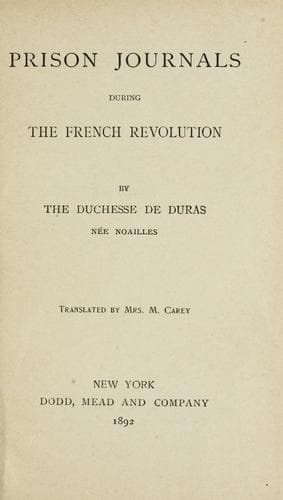
Prison Journals During the French RevolutionDuras, Louise Henriette Charlotte Philippine (de Noailles) de Durfort, duchesse de
History
Prison Journals During the French Revolution
Duras, Louise Henriette Charlotte Philippine (de Noailles) de Durfort, duchesse de
France -- History -- Revolution, 1789-1799 -- Personal narratives
As soon as we had been informed of the order to leave, we became
anxious to know whether all the prisoners at St. François were to be of
the party. Only a portion of them were destined at that time for
Chantilly. We passed the whole day in packing our belongings. Mine were
taken there from Mouchy, which spared me for that time the worry of
moving them, to which I was afterward compelled to accustom myself. I
forgot to say that the keeper of St. François was the most humane of
all under whom I was placed. I could not determine whether I was sorry
or glad to change my prison. Those to which I was going were infinitely
more wretched; but I did not then know their terrible methods.
About eleven o'clock at night we were told to get into the carriage,
but the train did not start till midnight. It was composed of wagons
and carriages of different sorts. I took in mine Monsieur de Reignac,
an officer of the King's Constitutional Guard, who was afterward
guillotined, a nun from the Hôtel-Dieu at Beauvais, and my
waiting-woman. My coachman, to whom this journey was exceedingly
distressing, wept the whole way. We were escorted by the Beauvais,
National Guard, part on foot and part on horseback. As it was moonlight
the people came out in front of their doors to hoot at us and throw
stones at us. The train which had preceded us had been insulted
infinitely worse. Monsieur Descourtils, an old and very estimable
soldier, who had on all occasions rendered services to the town of
Beauvais, and also Monsieur Wallon, the kind patron of the poor, were
treated in the most outrageous manner.
Our procession moved so slowly, and we stopped so often, that we did
not reach Clermont until eleven o'clock in the morning, after having
come six leagues. My nun, who was not accustomed to travelling in a
carriage, was almost nauseated all the way. I read throughout almost
the whole journey.
We dined at an inn in Clermont. The people watched us dismount with an
expression of pity. This feeling, which it is generally so undesirable
to inspire, gave us pleasure on account of its rarity during the Reign
of Terror. Nothing worthy of remark took place during our short stay at
Clermont, unless it was the manner in which we were guarded. Our
escort, being obliged to rest and get something to eat, confided us to
the care of the National Guard of the city, among whom there were some
prisoners who had been placed there to increase the size of the troop.
The vicinity of Fitz-James made me sadly recall memories of the past. I
had been so happy there from my earliest childhood; now nothing was
left me but to regret it; all those with whom I had spent my life there
were either dead or gone away. But while I was giving way to these sad
thoughts, we were told it was time to leave. The train started, and we
reached Chantilly at three o'clock.
Public-domain text, read in full here on John Shaqi.
Reviews
Reviews
No reviews yet
Be the first to share your thoughts on this work.
Join the Discussion
Join the discussion
Sign in to leave a comment or review.
Sign InorCreate an account