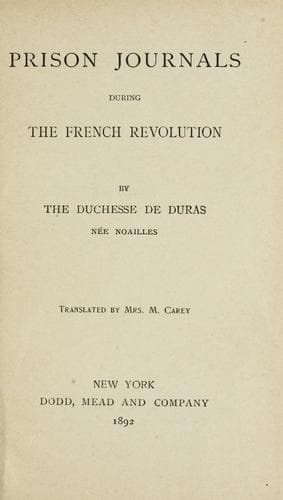
Prison Journals During the French Revolution — John Shaqi
Prison Journals During the French RevolutionDuras, Louise Henriette Charlotte Philippine (de Noailles) de Durfort, duchesse de
History
Prison Journals During the French Revolution
Duras, Louise Henriette Charlotte Philippine (de Noailles) de Durfort, duchesse de
France -- History -- Revolution, 1789-1799 -- Personal narratives
It would be difficult to describe the confusion caused by the unpacking
of the many vehicles loaded with mattresses and other things belonging
to the prisoners, all thrown haphazard in the court, without other
order than to unload them, and that the bundles should not be taken
upstairs till the next day, when there would be time to examine them.
Consequently it was the custom to go to bed on a chair the first night,
after a very scanty supper, or to accept the mattress of some prisoner
willing to deprive himself of it. As we passed the iron grating at the
entrance of the place, I recalled the 2d of September, and said to
Monsieur de Reignac that it was quite probable that we were being
gathered together to be made to submit to the same fate; he seemed to
think so too. Several attempts had been made to invent conspiracies,
which had in fact no real existence at Chantilly any more than in other
prisons. In order to render the name prison less terrible, they were
called houses of arrest, of justice, of detention, etc.; but as during
the Reign of Terror these words were synonyms, I shall make use of them
without distinction. The whole party was taken into a beautifully
gilded chapel, where I had heard Mass in the time of the Prince de
Condé. It was quite filled with bags of flour; I found one which was
placed in a comfortable position, and seated myself on it. Then the
steward of the house, by name Notté, member for the Department of the
Oise, mounted on the altar steps to call the roll, holding in his hand
the list of those who composed the party; he had on his right a man
named Marchand (who was the son of a very respectable waiting-woman of
my aunt, Madame la Maréchale de Noailles), an agent of the
Revolutionary army, who was in the confidence of the Committee of
Public Safety. He seemed to take pleasure, as the names of the priests
and nobles were called, in saying the harshest and most cutting things
to them. A village vicar from the environs of Beauvais, and I had the
worst of it all. This poor priest was quite in a tremor; but as for me,
I did not mind it at all. This man Marchand asked Notté if he had taken
care to see that I was very poorly lodged, and he replied that he had
selected for me the smallest room to be had. When the roll-call was
over, Mademoiselle Dubois, my waiting-woman, asked permission to remain
in prison with me. The commissioners refused her request, and declared
their determination of sending away all those not prisoners who up to
that time had remained in the place. She was much grieved at parting
from me. I was not sorry to give her up, for I had been extremely
worried to see her suffering and deprived of liberty on account of her
attachment to me. I remember with gratitude the feeling she showed for
me at that time, and I am very glad to record it in this memoir. After
a very long and wearisome discussion we left the chapel, quite curious
to see our new quarters. I was agreeably surprised when they conducted
Public-domain text, read in full here on John Shaqi.
Reviews
Reviews
No reviews yet
Be the first to share your thoughts on this work.
Join the Discussion
Join the discussion
Sign in to leave a comment or review.
Sign InorCreate an account