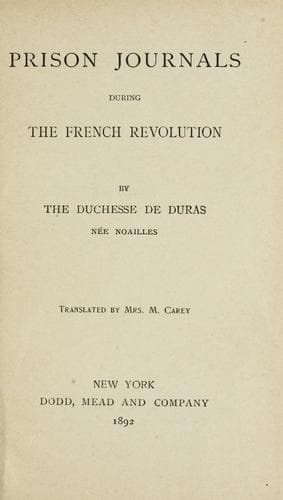
Prison Journals During the French RevolutionDuras, Louise Henriette Charlotte Philippine (de Noailles) de Durfort, duchesse de
History
Prison Journals During the French Revolution
Duras, Louise Henriette Charlotte Philippine (de Noailles) de Durfort, duchesse de
France -- History -- Revolution, 1789-1799 -- Personal narratives
me to a small room, neat and prettily gilded, where I was to be alone.
Notté had had the good manners to keep it for me. I valued it the more
when I saw the lodgings of my travelling companions. Several prisoners
came to see me. I was not acquainted with one of them. I seemed to have
been shipwrecked on an island inhabited by good people. They welcomed
me heartily, and I was permitted to have my belongings, which had come
from Mouchy, sent up to me at once. Consequently I had the pleasure of
sleeping on a bed,--a rare thing on the day of one's arrival. Several
of my neighbours were kind enough to help me make it up. I was quite
overcome, and terribly fatigued. I received all these kindnesses as
graciously as possible, but was impatient to be left to repose.
Mademoiselle de Pons, now Madame de Tourzel, came with a message from
her mother, asking me to supper; and Madame de Chevigné invited me to
breakfast next morning. I accepted the second invitation with pleasure.
I had never known these ladies intimately. They were the only ones
belonging to the court who were in the house. I had only met them at
the houses of my acquaintances.
The fatigue I had undergone the day before made me sleep. I had
scarcely risen when Mademoiselle Lèfvre, the sister-in-law of the
steward of Mouchy, came to my room to give me information
concerning the inhabitants of our prison, and advice about my own
arrangements,--all of which was very useful to me. It is a very sad
thing to find oneself utterly alone in the midst of a crowd.
Monsieur Notté paid me a visit; I did not find his face so severe
as it had seemed on the arrival of our party, when he stood beside
the commissioner of the Revolutionary army. He spoke pleasantly to
me, and told me that, as the prisoners were very much crowded in
their lodgings, he thought it best to put some one with me in a
little cabinet which was under my control. In order to enter it one
had to pass through my room. He allowed me to select the person,
and I chose the hospital sister who had come from Beauvais, with
me. She was a good woman, the daughter of a village farrier,
without education, but a great help to me in the daily needs of
life. I had an opportunity to show her my gratitude for it all
during a severe illness of hers, when I acted not only as her
nurse, but also as her physician, as she was not willing to see a
doctor. She frequently gave me proof of the fact that when one has
not received certain ideas in youth it is impossible to comprehend
some of the simplest things. I would alter my phrases in every
possible way in order to enable her to understand what I
meant,--among other things respect for opinion, etc. She remained
with me until I was removed to Paris, and was never annoying to me.
This was a great blessing, since our companionship was enforced. I
soon began to pay visits among our colony, which was composed of
very incongruous material. There were priests, nobles, nuns,
Public-domain text, read in full here on John Shaqi.
Reviews
Reviews
No reviews yet
Be the first to share your thoughts on this work.
Join the Discussion
Join the discussion
Sign in to leave a comment or review.
Sign InorCreate an account