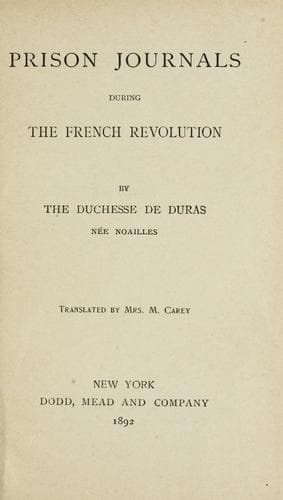
Prison Journals During the French RevolutionDuras, Louise Henriette Charlotte Philippine (de Noailles) de Durfort, duchesse de
History
Prison Journals During the French Revolution
Duras, Louise Henriette Charlotte Philippine (de Noailles) de Durfort, duchesse de
France -- History -- Revolution, 1789-1799 -- Personal narratives
I made some visits every day, and received visitors after dinner,
during which time I also worked. Sometimes some patriots whom I
recognized quite well, pretended to be aristocrats, so as to make me
talk; it was without doubt the most disagreeable part of the day. The
time passed without great weariness, for I filled it up with prayer and
reading, and a little walking in a courtyard, walled on four sides, and
very dreary looking. At first we were able to go to the grating and
talk with persons outside; but it was not desired that we should do
this, and to prevent it planks were placed over the grating. These
concealed the outer view and made communication impossible. On the
third story there were terraces on the leads, upon which all our
windows opened; and these windows, in several instances, also served as
doors; only one person could pass through them at a time. It was really
a comical sight, this file of prisoners, dressed in all sorts of
costumes, and going around and around like a panorama. We were
frequently obliged to stop on account of the great number of
promenaders. Mademoiselle de Pons, who played on the piano, accompanied
on the violin by Monsieur de Corberon (an officer of the French Guards,
who was afterwards guillotined), entertained us most agreeably; she
occupied one of the apartments of which I have just spoken. The view
from it was very pleasant,--the most beautiful rippling waters,
numerous villages, a superb forest, fine buildings belonging to the
château, and a green lawn most charming to look upon. I thoroughly
examined every portion of our prison. Several of the large rooms had
been divided by plank partitions which were only six or seven feet
high. Those who occupied these compartments during the winter suffered
excessively from cold. In the rooms which were not so divided there
were put as many as twenty-five persons. I noticed the arrangement of
one of these communities, in which the curtain-less beds were placed so
close together that during the day the prisoners, in order to move
around, were obliged to pile them up on top of one another. Here is a
list of the individuals occupying this room: A republican general and
his wife, a curate from Noyon, twenty-seven years old, several young
men, two estimable mothers of families, with five or six daughters from
fourteen to twenty years. In another there were a soldier with two or
three nuns. The one next to mine contained a general, called Monsieur
de Coincy, eighty-three years old, who still retained his strength, his
wife, his son, his daughter, a nun of the Visitation, and
Mesdemoiselles de Grammont-Caderousse, the eldest of whom was about
fourteen. A special annoyance in our prison was the mingling of the
sexes in the same lodging. I was the more thankful for my little cell.
Marchand, the commissioner of the Revolutionary army, came to make me a
visit; he found nothing to complain of in the furnishing of my
Public-domain text, read in full here on John Shaqi.
Reviews
Reviews
No reviews yet
Be the first to share your thoughts on this work.
Join the Discussion
Join the discussion
Sign in to leave a comment or review.
Sign InorCreate an account