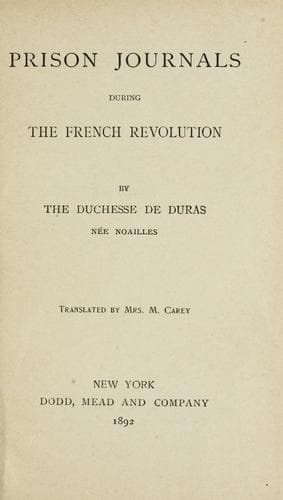
Prison Journals During the French RevolutionDuras, Louise Henriette Charlotte Philippine (de Noailles) de Durfort, duchesse de
History
Prison Journals During the French Revolution
Duras, Louise Henriette Charlotte Philippine (de Noailles) de Durfort, duchesse de
France -- History -- Revolution, 1789-1799 -- Personal narratives
apartment, which was composed of a servant's bed, two chairs, and a
table. The beds and the trunks served as seats when the company was too
numerous. Generally luxury was an offence to him. I told him he could
find no fault with mine. I was mistaken; he answered that I as well as
my parents had once had too much of it. He went from one end to the
other of the place, and took it into his head, in order to annoy those
ladies who seemed somewhat careful of their toilets, to order them to
have their hair cut off; and he also sent _sans-culottes_ to sleep in
their rooms. These poor fellows were as much worried at this as those
who were compelled to submit to it. They used to come as late as they
possibly could and go away very early in the morning. They were very
well behaved, with the exception of a cobbler from Compiègne, of whom
his hosts complained bitterly; he was ill-tempered and annoying. One of
his comrades, probably better reared, came near dying of colic through
his politeness in not wishing to awaken those with whom he was forced
to lodge.
Care had been taken, in order to avoid too active a correspondence
between the prisoners and outsiders, to send those who were inhabitants
of the district of Senlis to the abbey of St. Paul at Beauvais, and
those of Beauvais, to Chantilly. We could not write even to our
parents, nor could we receive news from them without a great deal of
trouble. Of all the privations we were forced to undergo, this was the
hardest to bear. While Notté was at the head of the house, the
prisoners continually complained of him, though our situation was
endurable. The wretched are naturally fault-finding.
I assured them that if he went away it would be worse for us; and so it
actually happened. This man was passionate but not wicked. I had found
out that one should never ask him anything in the presence of other
persons, because he feared lest they might be indiscreet; but in
private he was quite accommodating. I never had any reason to complain
of him. By one of the strange chances of the Revolution, he is now in
want, and at the very time when I am writing this memoir, is soliciting
my protection, which I would willingly grant him if it were better
worth having.
I was generally strictly obedient to the rules of the household, and
consequently had to endure fewer annoyances than those who strove to
evade them. It is true that they changed so frequently that it was
difficult to keep the run of them.
We were guarded at first by the gendarmerie, afterward by the National
Guard of Chantilly. I was informed of this by a carpenter who, while
doing some work in my room, told me he was now our military commander.
I found it necessary to ask his permission to do something the next
day, and I did so in such a serious manner that Madame Séguier, who was
present, could not help laughing.
Public-domain text, read in full here on John Shaqi.
Reviews
Reviews
No reviews yet
Be the first to share your thoughts on this work.
Join the Discussion
Join the discussion
Sign in to leave a comment or review.
Sign InorCreate an account