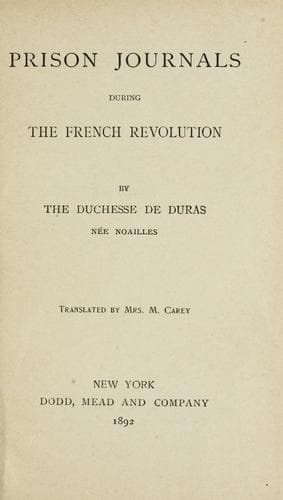
Prison Journals During the French RevolutionDuras, Louise Henriette Charlotte Philippine (de Noailles) de Durfort, duchesse de
History
Prison Journals During the French Revolution
Duras, Louise Henriette Charlotte Philippine (de Noailles) de Durfort, duchesse de
France -- History -- Revolution, 1789-1799 -- Personal narratives
One day as we were dining in the gallery of the Petit Château, I
recalled the beautiful pictures which formerly adorned it, the armour
of the great Condé, pierced with bullets, his victories represented by
the great painters, all the festivals I had attended in that place; but
happily these ideas came to me rarely. I generally had there very
commonplace thoughts; those which concerned my bill of fare,--such as
the endeavour to introduce into it, by means of bribery, a pound of
butter or a few eggs,--absorbed me. In this connection I had a very
amusing encounter with our new commissioner, named Perdrix. This man
had a grotesque figure, and wore a costume not less so. His former
profession had been to paint the dogs of Monsieur the Prince of Condé.
He probably imagined it would add to his dignity to be more severe than
his predecessors. We were allowed to speak to him only through an
opening made in the wall. I one day presented myself at this strange
parlour to ask him to allow me to have six pounds of chocolate which he
had held back; he replied with dignity that he would allow me exactly
as much of it as was good for my stomach. I assured him that in order
to have the dose exact the only way was to have me breakfast every
morning with the surgeon, and said moreover, that I wanted to give it
to a sick man. He did not grant my request, and I went away somewhat
angry at not being able to obtain the nourishment which kept up my
strength. My charwoman, who fortunately was also his, brought back to
me the full supply the next day.
I will leave off these small details, and tell how a poor soldier of
the Revolutionary army, the father of a family, being unacquainted with
Chantilly, arrived there in the night, and losing his way, fell into
one of the moats which surrounded the castle. At daybreak some of the
prisoners saw the man struggling and screaming. Monsieur de
Bouquerolle, an officer of the navy, who knew how to swim (he was the
eldest son of the much respected family of Boury), started to go into
the water after him. The sentinel prevented his doing so, telling him
that it was a prisoner who had escaped, and left the man to perish. His
body was found afterward, and it was recognized as that of one of their
own men. Monsieur de Corberon and a curate asked that the body should
be brought into the house, in order to try the usual means of restoring
the drowned to life. This was granted them; and they used every means
in their power for several hours, but without success. After this act
of cruelty one can imagine how incensed the prisoners were. Well, they
had their revenge in taking up a collection for the widow and children
which amounted to six hundred francs. These were the people who during
the Revolution were called criminals.
Public-domain text, read in full here on John Shaqi.
Reviews
Reviews
No reviews yet
Be the first to share your thoughts on this work.
Join the Discussion
Join the discussion
Sign in to leave a comment or review.
Sign InorCreate an account