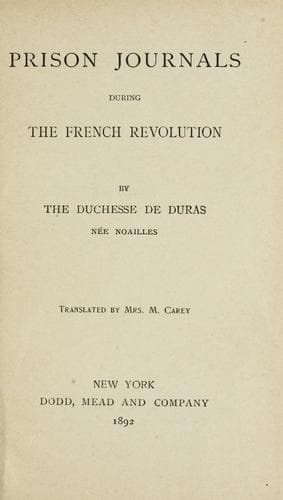
Prison Journals During the French RevolutionDuras, Louise Henriette Charlotte Philippine (de Noailles) de Durfort, duchesse de
History
Prison Journals During the French Revolution
Duras, Louise Henriette Charlotte Philippine (de Noailles) de Durfort, duchesse de
France -- History -- Revolution, 1789-1799 -- Personal narratives
A table was set in the gilded gallery of the Petit Château,[3] without
a cloth, and with two hundred covers. The tables were reset three
times, for there were many more than six hundred prisoners in the
house; but the old and infirm were allowed to remain in their
apartments. One of the tables was occupied by priests and unmarried
men, the second by married people and children, the third by those who
were alone; and this was my situation. The places were all numbered,
and each of us had a duplicate number. When the bell rang, we came like
children going to school, with baskets, in which were our plates,
goblets, etc. Often the previous dinner was not over, and we had to
stand a long time in groups in the drawing-room, which was next the
gallery. We ate soup, which was only water with a few lentils such as
are fed to horses, grass for spinach, sprouted potatoes, and a
perfectly disgusting stew called _ratatouille_. I suppose that this
word is not in the dictionary of the Academy, and that the Institute is
not likely to put it there. We rose from the table hungry. There was a
very hearty young man to whom we used to send all that was left at our
table, in order to appease his hunger in some degree.
The members of the Revolutionary committee, with the officers of our
guard, marched around our table with their red caps on their heads.
There was one of them--the peruke-maker for the whole company--who
watched us closely, to see if any one abstained from meat. Under such
circumstances it was not easy to keep Lent. Many persons, however, did
keep it strictly, although the grand vicars of the diocese had exempted
three days.
Our tables were surrounded by sentinels of the Revolutionary army. I
sometimes conversed with them. I found one among them to whom his
service was extremely disagreeable. He was a servant whom want had
compelled to take such a wretched position. He pitied us, and would
willingly have afforded some alleviation of our terrible condition. One
of the guards' duties was to accompany, with drawn sabres, the
washerwomen when they came to bring and carry away our linen. This
performance was truly humiliating, and I made some effort to avoid its
most embarrassing details.
One day a commissioner delivered a most atrocious reproof to the
keeper. He told him that there did not enough prisoners die in the
house. In fact, through lack of care, the bad food, and the incapacity
of the health officers, a great many would have died; but Providence
protected them, and their constitutions held out much better than could
have been expected.
Public-domain text, read in full here on John Shaqi.
Reviews
Reviews
No reviews yet
Be the first to share your thoughts on this work.
Join the Discussion
Join the discussion
Sign in to leave a comment or review.
Sign InorCreate an account