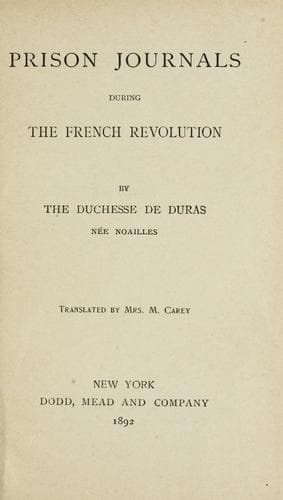
Prison Journals During the French RevolutionDuras, Louise Henriette Charlotte Philippine (de Noailles) de Durfort, duchesse de
History
Prison Journals During the French Revolution
Duras, Louise Henriette Charlotte Philippine (de Noailles) de Durfort, duchesse de
France -- History -- Revolution, 1789-1799 -- Personal narratives
Suddenly a party of forty prisoners were set at liberty in accordance
with a command from their communes, under a law which granted the
communes this right. There was general rejoicing among those who
departed, and sweet hope for those who remained; but it was seen that
by this means the prisons would be emptied, and the law was repealed. I
was glad to take leave of two good Sisters of Charity from Noyon,
thinking of all they would do for the poor whom they cared for so
tenderly; but scarcely had a few prisoners been set at liberty when a
larger number came to replace them. The districts of Beauvais, Noyon,
Senlis, and Compiègne were most zealous in gathering recruits. We never
had any vacancies. One day I met an old nun whom I did not know, bent
with age and infirmities, who seemed to be suffering terrible pain in
the side of her face. One of her companions told me that as she was
getting into the wagon which brought her to Chantilly she made the sign
of the cross; and one of the soldiers of the escort was so indignant
that he gave her a frightful blow on her cheek which broke several of
her teeth. How horrible! I took great pleasure in visiting these holy
virgins, who were inconsolable at being compelled to leave their
retreats where peace and innocence reigned. In order to console them
for this, they were lodged so close to the coarsest men in the house
that they constantly heard things said which made them very unhappy.
They endured their strange and terrible situation with perfect
resignation, and never failed to read their office as though they were
in their convent.
My companions in misfortune differed very much; there were some who, in
the hope of obtaining their liberty, undertook the rôle of informer.
Several of them tried to sound me; they were not rewarded for their
trouble. When they told me tales I would not listen, but immediately
changed the conversation.
One thing which astonishes me as I look back is how little I suffered
from _ennui_ during my captivity. My thoughts were confined within a
very narrow sphere. They dwelt upon my regret at being separated from
those I loved and upon the needs of my daily life. The want of
exercise, which is absolutely necessary to me from habits contracted in
my childhood, gave me too great fulness of blood. I had violent rushes
of blood to the head, and also rheumatism. Once on awakening I felt so
stunned that I called the hospital nurse, who lodged near me. She
thought I was dying, and went for help. This condition, which was
really dangerous, was relieved by vomiting. I fell asleep; and when I
woke I found myself surrounded by kind people, to whom I acknowledged
my gratitude, and then burst into tears. They did not know what to make
of it. I excused myself, and explained to them that once several years
before I had had a similar attack, when I was surrounded by friends and
relatives, and now I was terribly alone. I regained my composure, and
then went out into the air.
Public-domain text, read in full here on John Shaqi.
Reviews
Reviews
No reviews yet
Be the first to share your thoughts on this work.
Join the Discussion
Join the discussion
Sign in to leave a comment or review.
Sign InorCreate an account