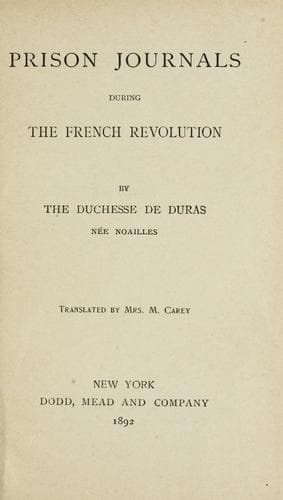
Prison Journals During the French Revolution — John Shaqi
Prison Journals During the French RevolutionDuras, Louise Henriette Charlotte Philippine (de Noailles) de Durfort, duchesse de
History
Prison Journals During the French Revolution
Duras, Louise Henriette Charlotte Philippine (de Noailles) de Durfort, duchesse de
France -- History -- Revolution, 1789-1799 -- Personal narratives
The weak condition to which I was reduced made me unable to restrain
the feelings and emotions which these sad memories aroused, though
generally I have an aversion to speaking of what grieves me. The health
officer of the prison was sent for; he was a violent revolutionist,
small, very dark, uneducated, and dressed in a _carmagnole_, the
uniform of the _sans-culottes_. Being difficult to bleed, I dared not
have him bleed me, although I was in great need of it. He put leeches
on my neck, which eased the pains in my head.
Very disturbing news reached us from Paris, and those were the only
tidings which could come to us. It was reported that we were to be
interrogated by means of blanks, which must be filled up. I had a great
dread of this kind of torture on account of my love of truth, which
might compromise both myself and others. Heaven did not allow them to
realize this base project.
One of the prisoners died from the mistaken treatment of that imbecile
surgeon, who, without asking him if he had hernia, gave him an emetic,
which caused his death in twenty-four hours.
The treatment of the sick was terrible; no medicine was given them, no
one was appointed to nurse them, and even the prisoners were forbidden
to show them any attention. I once saw five cases of putrid fever in
one room. A respectable girl from Crépy, who stayed in the apartment,
was obliged to spend every night waiting on the patients. A good
schoolmaster, who also was in the room, helped her as well as he could.
I have seen him since, with great pleasure, and I entertain a real
esteem for him.
Madame de Boursonne, who had recovered from her illness, and from the
visit of the revolutionists, heard that Monsieur d'Ecquevilly, her
father, was dying at Amiens. One may imagine her great desire to go to
him and hear his last words; but an insurmountable barrier was placed
between us and those dear to us. She could only hope to hear frequently
from him, being very near him; but our keeper, Perdrix, refused even
this, and kept all letters addressed to her. After a fortnight of
terrible suspense had passed, he sent for her to come to him; this was
for the purpose of reading to her, in the presence of every one, the
letter announcing the death of her father, without even allowing her to
have it, which at least would have given her the consolation of
learning the details. Poor Madame de Boursonne was in a terrible state.
I did everything in my power for her, and took her back to her own room.
Public-domain text, read in full here on John Shaqi.
Reviews
Reviews
No reviews yet
Be the first to share your thoughts on this work.
Join the Discussion
Join the discussion
Sign in to leave a comment or review.
Sign InorCreate an account