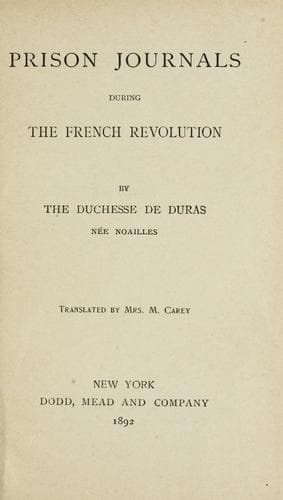
Prison Journals During the French Revolution — John Shaqi
Prison Journals During the French RevolutionDuras, Louise Henriette Charlotte Philippine (de Noailles) de Durfort, duchesse de
History
Prison Journals During the French Revolution
Duras, Louise Henriette Charlotte Philippine (de Noailles) de Durfort, duchesse de
France -- History -- Revolution, 1789-1799 -- Personal narratives
A month had passed since we left Chantilly when a party arrived, among
whom was Madame de Pons, to whom I restored the precious charge which I
had been so happy as to keep for her; I was then left in sole
possession of my room, which I enjoyed very much. I was informed that
it was proposed to separate the suspected persons from those indicted
by the Revolutionary tribunal, and to place us in a building facing
that we were now occupying. This change seemed so advantageous to us
that we urged the keeper to carry it out as quickly as possible. To do
him justice, he behaved very well on this occasion, using his influence
with the terrible Fouquier-Tinville to prevent our being mistaken for
the indicted prisoners, and to effect our removal without delay. I
regretted for a moment the loss of the beautiful view from my
apartment; all the fine buildings in Paris were before me,--the
cathedral, St. Sulpice, the Val-de-Grâce, etc. I remembered that on
Easter Day, as I was grieving over the thought that the holy sacrifice
was no longer offered up in those temples made so venerable by their
antiquity, and the prayers of the faithful, I joined in the prayers of
those whose faith was strong, and who were sharing my sad thoughts, and
found that I was really more edified than I had often been on that holy
day when at the foot of the altar.
At last the order came for us to leave our apartments, and carry our
effects with us. One person was sufficient to assist me in my moving; a
wretched pallet, a straw chair, and a few dishes composed my only
furniture. The moment of our departure was very trying to those who
remained still under the power of the public accuser. Several of them
wept when we left them. The separation was final.
When I reached my new prison it seemed to me a mansion, since there
were only two gratings instead of six, as before; and as the men were
entirely separated from the women, we were allowed to go all over the
building, from top to bottom, without a keeper. I was lodged on the
fifth floor, in what was called formerly 'the philosophers'
warming-place'. The names of the scholars were, as is customary,
written in charcoal on the walls; I recognized a few of them. There was
a fireplace in this pretty room, and I think it was the only one in the
corridor. It was immediately made use of to warm all my neighbours'
coffee-pots, which occasioned a continual procession not at all
agreeable.
Public-domain text, read in full here on John Shaqi.
Reviews
Reviews
No reviews yet
Be the first to share your thoughts on this work.
Join the Discussion
Join the discussion
Sign in to leave a comment or review.
Sign InorCreate an account