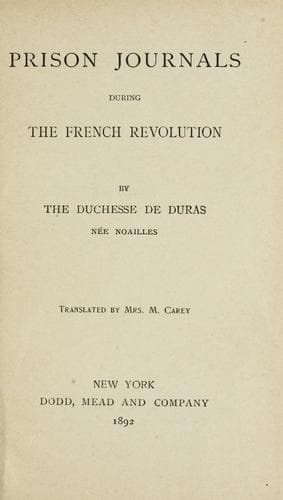
Prison Journals During the French RevolutionDuras, Louise Henriette Charlotte Philippine (de Noailles) de Durfort, duchesse de
History
Prison Journals During the French Revolution
Duras, Louise Henriette Charlotte Philippine (de Noailles) de Durfort, duchesse de
France -- History -- Revolution, 1789-1799 -- Personal narratives
Before my detention, I had thought that a prison would be at least a
place of repose, where I could give myself up to study; but this was
not the case at all, at least not in those where I stayed. Every moment
the keeper, the jailers, the turnkeys, the purveyors, etc., came in. We
were made to go down to the clerk's office to attend to our
commissions. I could not read one single hour without interruption. One
thing which I have heard spoken of, and which I have certainly
verified, is the habit prisoners have of being destructive. It arises
from their standing in need of a thousand things. I had no shovel, so I
broke a piece of slating and used it for one; I took a floor-tile for a
lid. It was very difficult to procure wood, so I burned up my chairs.
We could not send a keeper down-stairs without paying him a hundred
sous.
In spite of the admiration inspired by my new dwelling-place, I was
forced to sigh for the one I had left. We slept where the plaster was
quite fresh, which gave me such a raw sensation in my throat that I
could swallow nothing but milk. On the stairways there was a very
unwholesome smell of oil; all the windows, above and below, had been
grated, and boards adjusted, so as to make it impossible to throw
letters out. The outer aspect of our building was frightful. We lost by
our transfer the promenade in the garden, and had instead one no better
than in the courtyard at Plessis, so that one could not make up one's
mind to go out except when it was absolutely necessary to go in the
open air. The men and women went there at different hours. They were
shut in on every side; and walls had been erected so that the prisoners
could not be seen by their neighbours, and could make no sign to them.
One little alley-way, however, which it was impossible to shut out from
our view, allowed us to see human beings at liberty, or who at least
believed themselves to be. The windows which procured this little view
for us were very much sought after and always occupied. Persons
interested in the prisoners came to assure themselves of our existence.
Our numbers increased each day, and brought us some detestable
recruits. I had very near me some vulgar creatures,--young women from
the Rue de Chartres, some persons with the itch, the hangman's
mistress, and a drunken creature, who said she was a person of quality
belonging to the family of Désarmoise, to whom in manner at any rate
she bore not the slightest resemblance. She assumed the right to come
into our rooms every day, make a great noise, and deliver herself of
the most abusive language, for which she afterward asked pardon. I was,
of course, very much touched by her repentance, but her visits were
still very disagreeable to me. Another of my neighbours, a lady of the
court, was insane; and unfortunately for me, she took a great fancy to
me. She lay down to sleep one day just in my doorway, and could only be
gotten away by force. The sort of care that I was obliged to take of
Public-domain text, read in full here on John Shaqi.
Reviews
Reviews
No reviews yet
Be the first to share your thoughts on this work.
Join the Discussion
Join the discussion
Sign in to leave a comment or review.
Sign InorCreate an account