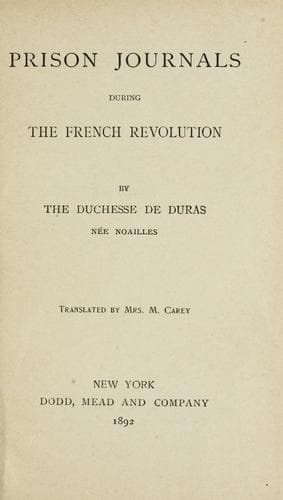
Prison Journals During the French RevolutionDuras, Louise Henriette Charlotte Philippine (de Noailles) de Durfort, duchesse de
History
Prison Journals During the French Revolution
Duras, Louise Henriette Charlotte Philippine (de Noailles) de Durfort, duchesse de
France -- History -- Revolution, 1789-1799 -- Personal narratives
We were not allowed to have any light in our rooms; this was a very
great privation. To room in front of a street lamp was a great piece of
good fortune. In the corridors were placed chaffing-dishes, on which we
warmed our suppers. Those of us who had fireplaces kept the fires
bright, so as to give light. Some one would light a candle for a
moment, then extinguish it the next, for fear of being punished. To eat
with our fingers was intolerable. To go to the jailer every day to ask
him to cut up our chocolate was neither amusing nor satisfactory. I
remember a large penknife which belonged to Madame Vassy which was our
delight. She was a lovely woman, bright and intelligent, and extremely
obliging. She said she liked variety. She married, on leaving the
prison, a Prussian, who took her to Berlin.
On the 18th of June I witnessed a heart-rending scene. I was in Madame
de Pon's apartment, playing a game of chess with her, when some one
came and called me; I went out. A person who felt an interest in Madame
de Pon's daughter told me that her father had been transferred from the
private hospital where he had been, to the Plessis, and that as he was
getting out of the wagon he had received his bill of indictment; that
he implored most earnestly to be allowed to see his daughter, but was
refused, in order to avoid such a harrowing interview. The windows of
the keeper's apartment opened directly upon the courtyard where
Mademoiselle de Pons was then walking; they were ordered to be closed.
Monsieur de Pons gave himself up to the most frenzied despair, saying
that the most precious treasure he had in the world was taken from him.
We did not know how to get his daughter out of the courtyard without
arousing her suspicions. Haly had caused her to suspect that something
was going on, by forbidding her to go under the windows on account of
the arrival of some new prisoners. I made some pretext to persuade her
to go into our building with one of my friends; and the latter led her
to a place quite away from her unfortunate father. Then I returned to
Madame de Pons's room, and from the change in my countenance she
perceived that something had happened. I said nothing, but began
playing chess again, in order to gain time to prepare her for it. The
state of affairs between herself and her husband rendered this less
terrible for her than for her daughter. She urged me to tell her the
cause of my emotion. As Monsieur de Pons had been ill of consumption
for a long time, I told her that he was about to die. She begged me not
to tell her daughter of it, and I promised. This unhappy man was not
sent for to be taken to the Conciergerie until nine o'clock in the
evening, and consequently he was in the same building with his child
for five hours without being able to take her in his arms, comfort her,
or bid her a last farewell. He spent all of the time in seeking by
threats and prayers to excite the compassion and interest of the
Public-domain text, read in full here on John Shaqi.
Reviews
Reviews
No reviews yet
Be the first to share your thoughts on this work.
Join the Discussion
Join the discussion
Sign in to leave a comment or review.
Sign InorCreate an account