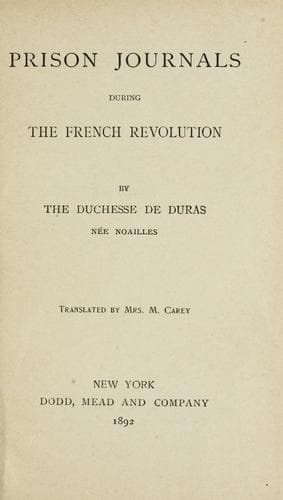
Prison Journals During the French RevolutionDuras, Louise Henriette Charlotte Philippine (de Noailles) de Durfort, duchesse de
History
Prison Journals During the French Revolution
Duras, Louise Henriette Charlotte Philippine (de Noailles) de Durfort, duchesse de
France -- History -- Revolution, 1789-1799 -- Personal narratives
keeper, telling him of her youth, of his affection for her, and that
his last prayer was that happier days might be in store for her. He
cast a farewell glance toward the courtyard, and then was led away. I
spent the evening in extreme trouble and agitation; although I knew
Monsieur de Pons only very slightly, the thought that he had not in his
last agonized hours been able to see his daughter and bless her, and
the grief I knew she would feel, all caused me to pass a terrible
night. The young girl has since told me that she suspected that
something sad was being concealed from her, by the embarrassment in our
manner toward her. She came the next day as usual to my apartment to
comb my thin white hair, and I could scarcely restrain my feelings
while I was dressing when I remembered that her father was at that very
moment before the tribunal or mounting the scaffold. She went away
immediately. Madame de Pons had asked me to tell her the whole truth,
and I had done so. She had sent for news of her husband's trial, and
learned that he and also Messieurs de Laval, de Rohan-Soubise, de
Monterrey, and fifty others had been condemned to death as conspirators
against Robespierre, and were to be executed at the Grève, wearing red
shirts, though these by law were required to be worn only by murderers.
It seems that in order to make this so-called conspiracy more noted,
the most celebrated names of the old régime, had been made use of, and
that in fact those who bore them had never thought of conspiring.
All day means were employed to increase Mademoiselle de Pons's anxiety
on account of her father's illness as she knew he was in great danger,
and feared his end was approaching. She says in one of her prison
memoirs, of which a few copies have been printed, that I asked
permission of her mother to tell her of her father's death. She did not
know that, on the contrary, it was Madame de Pons who earnestly
implored me to undertake to break it to her, and that for a long time I
refused. At last she gave me some very good reasons for doing so, and I
consented. Mademoiselle de Pons, in whose presence I no longer
concealed my emotion, suspected her misfortune. She questioned me; I
made no reply, but threw my arms around her and burst into tears.
Public-domain text, read in full here on John Shaqi.
Reviews
Reviews
No reviews yet
Be the first to share your thoughts on this work.
Join the Discussion
Join the discussion
Sign in to leave a comment or review.
Sign InorCreate an account