The tendency of any executive, in war time, is to consider any
criticism as a check on war effort. It is. If a commanding officer has
to take five minutes to explain an order, five minutes are lost; if
the President, or the head of OPM, has to defend an action or reply to
a critic, energy is used up, time is lost. But time and energy may be
lost a hundred times more wastefully if the explanation is not given,
if the criticism is not uttered and grows internally and becomes
suspicion and fear. Freedom of criticism is, in our country, a
positive lever for bringing morale into logical relation to events.
The victims of criticism can use it positively, their answers can
create confidence; and best of all, it can be anticipated, so that it
can do no harm.
But this is true only if the right to criticize is subtly transformed
into a duty; if, in doing his duty, the citizen refuses to criticize
until he is fully informed; if the State makes available to the
citizen enough information on which criticism can be based. Then the
substance and the intention of criticism become positive factors in
our fight for freedom.
Since it is freedom we are fighting for.
Freedom, nothing else, is the source of unity--our purpose in the war,
our reason for fighting. On a low level of survival we have forgotten
some of our differences and combined our forces to fight because we
were attacked; on the high level which makes us a nation we are united
to fight for freedom, and this unites us to one another because it
unites us with every American who ever fought for freedom. Most
particularly our battle today unites us with those who first
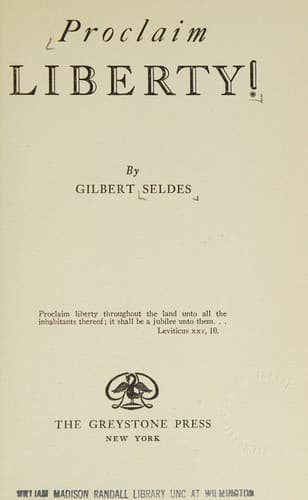
proclaimed liberty throughout the land.
CHAPTER V
The Forgotten Document
To distract attention, to put people's minds on useless or bewildering
projects is a bit of sabotage, in a total war. It is well enough to
divert people, for a moment, so that they are refreshed; but no one
has the right to confuse a clear issue or to start inessential
projects or to ask people to look at anything except the job in hand.
For five minutes, I propose a look at the Declaration of Independence,
because it is the one document essential to our military and moral
success; it is the standard by which we can judge the necessity of all
projects; and although our destiny, and the means to fulfill it, are
written into it, the Declaration is the forgotten document of American
history. We remember the phrases too often repeated by politicians and
dreamers; we do not study the hard realistic plan of national action
embodied in every paragraph of the instrument.
The famous phrases at the beginning give the moral, and revolutionary,
reason for action; the magnificent ground plan of the character and
history of the American people is explained in the forgotten details
of the Declaration; and nothing in the conservative Constitution could
do more than delay the unfolding of the plan or divide its fruits a
little unevenly.
Public-domain text, read in full here on John Shaqi.
Reviews
Reviews
No reviews yet
Be the first to share your thoughts on this work.
Join the Discussion
Join the discussion
Sign in to leave a comment or review.
Sign InorCreate an account