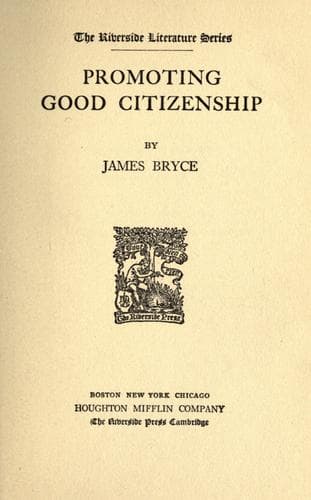
Promoting good citizenshipBryce, James Bryce, Viscount
Philosophy
Promoting good citizenship
Bryce, James Bryce, Viscount
Citizenship
Such a spirit is sometimes evoked by a great national crisis which
thrills all hearts. This happened to England or at least to a large
part of the people of England, in the seventeenth century. It happened
to Germany in the days of the War of Liberation, and to Italy when
she was striving to expel the Austrians and the petty princes who
ruled by Austria’s help. You here felt it during the War of Secession.
Sometimes, and usually at one of these crises, a great man stands out
who helps to raise the feeling of his people and inspire them with his
own lofty thoughts and aims. Such a man was Mazzini, seventy years
ago in Italy. Such were Washington and Lincoln, the former more by his
example than by his words, the latter by both, yet most by the quiet
patience, dignity, and hopefulness which he showed in the darkest
hours. Nations respond to the appeal which such a man makes to their
best instincts. He typifies for the moment whatever is highest in them.
Unhappily, with nations as with individuals, there is apt to be a
relapse from these loftier moods into the old common ways when selfish
interest and trivial pleasures resume their sway. There comes a sort
of reaction from the stress of virtue and strenuous high-soaring
effort. Everything looks gray and dull. The divine light has died out
of the sky. This, too, is an oft-repeated lesson of European history.
Yet the reaction and decline are not inevitable. When an individual
man has been raised above himself by some spiritual impulse, he is
sometimes able to hold the ground he has won. His will may have been
strengthened. He has learnt to control the meaner desires. The impulse
that stirred him is not wholly spent, because the nobler thoughts and
acts which it prompted have become a habit with him. So, too, with
a nation. What habits are to the individual man, that, to a nation,
are its Traditions. They are the memories of the Past turned into
the standards of the Present. High traditions go to form a code of
honour, which speaks with authority to the sense of honour. Whoever
transgresses that code is felt to be unworthy of the nation, unfit to
hold that place in its respect and confidence which the great ones
of the days of old have held. Pride in the glorious foretime of the
race and in its heroes sustains in the individual man who is called
to public duty, the personal pride which makes him feel that all his
affections and all his emotions stand rooted in the sense of honour,
which is, for the man and for the nation, the foundation of all virtue.
Public-domain text, read in full here on John Shaqi.
Reviews
Reviews
No reviews yet
Be the first to share your thoughts on this work.
Join the Discussion
Join the discussion
Sign in to leave a comment or review.
Sign InorCreate an account