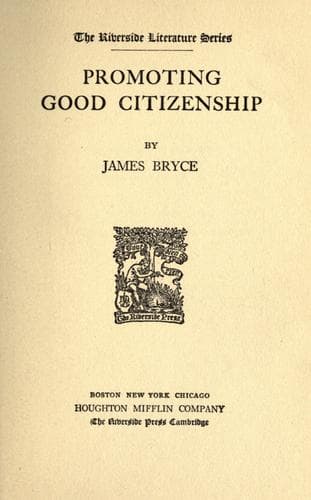
Promoting good citizenshipBryce, James Bryce, Viscount
Philosophy
Promoting good citizenship
Bryce, James Bryce, Viscount
Citizenship
We have seen in our own time, in the people of Japan, a striking
example of what the passionate attachment to a national ideal can do
in war to intensify the sense of duty and self-sacrifice. A similar
example is held up to us by those who have recorded the earlier annals
of Rome. The deepest moral they teach is the splendid power which the
love of Rome and the idea of what her children owed to her exercised
over her great citizens, enabling them to set shining examples of
devotion to the city which the world has admired ever since. Each
example evoked later examples in later generations, till at last in
a changed community, its upper class demoralized by wealth and power
even more than it was torn by discord, its lower classes corrupted
by the upper and looking on their suffrage as a means of gain, the
ancient traditions died out. Whoever, studying the conditions of modern
European democracies, sees the infinite fatalities which popular
government in large countries full of rich men and of opportunities for
acquiring riches, offers for the perversion of government to private
selfish ends, will often feel that those European States which have
maintained the highest standard of civic purity have done it in respect
of their Traditions. Were these to be weakened, the fabric might
crumble into dust.
Every new generation as it comes up can make the traditions which it
finds better or worse. If its imagination is touched and its emotions
stirred by all that is finest in the history of its country, it learns
to live up to the ideals set before it, and thus it strengthens the
best standards of conduct it has inherited and prolongs the reverence
felt for them.
The responsibility for forming ideals and fixing standards does not
belong to statesmen alone. It belongs, and now perhaps more largely
than ever before, to the intellectual leaders of the nation, and
especially to those who address the people in the universities and
through the press. Teachers, writers, journalists, are forming the
mind of modern nations to an extent previously unknown. Here they
have opportunities such as have existed never before, nor in any
other country, for trying to inspire the nation with a love of truth
and honour, with a sense of the high obligations of citizenship, and
especially of those who hold public office.
Of the power which the daily press exerts upon the thought and the
tastes of the people through the matter it scatters among them, and
of the grave import of the choice it has always and everywhere to make
between the serious treatment of public issues and that cheap cynicism
which so many readers find amusing, there is no need to speak here. You
know better than I do how far those who direct the press realize and
try to discharge the responsibilities which attach to their power.
Public-domain text, read in full here on John Shaqi.
Reviews
Reviews
No reviews yet
Be the first to share your thoughts on this work.
Join the Discussion
Join the discussion
Sign in to leave a comment or review.
Sign InorCreate an account