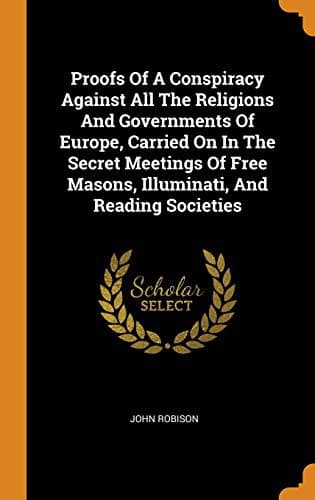
Proofs of a Conspiracy against all the Religions and Governments of Europe: carried on in the secret meetings of Free Masons, Illuminati, and reading societies.Robison, John
History
Proofs of a Conspiracy against all the Religions and Governments of Europe: carried on in the secret meetings of Free Masons, Illuminati, and reading societies.
Robison, John
Freemasonry -- Early works to 1800; Illuminati -- Early works to 1800
The Lodges being in this manner frequented by persons of various
professions, and in various ranks of civil society, it cannot be
supposed that the employment in those meetings related entirely
to the ostensible profession of Masonry. We have no authentic
information by which the public can form any opinion about it. It
was not till some years after this period that the Lodges made
open profession of the cultivation of general benevolence, and
that the grand aim of the Fraternity was to enforce the exercise
of all the social virtues. It is not unlikely that this was an
after-thought. The political purposes of the association being once
obtained, the conversation and occupations of the members must
take some particular turn, in order to be generally acceptable.
The establishment of a fund for the relief of unfortunate Brethren
did not take place till the very end of last century; and we may
presume that it was brought about by the warm recommendations
of some benevolent members, who would naturally enforce it by
addresses to their assembled Brethren. This is the probable origin
of those philanthropic discourses which were delivered in the
Lodges by one of the Brethren as an official talk. Brotherly love
was the general topic, and this, with great propriety, when we
consider the object aimed at in those addresses. Nor was this
object altogether a novelty. For while the manners of society were
yet but rude, Brother Masons, who were frequently led by their
employment far from home and from their friends, stood in need of
such helps, and might be greatly benefited by such an institution,
which gave them introduction and citizenship wherever they went,
and a right to share in the charitable contributions of Brethren
who were strangers to them. Other incorporated trades had similar
provisions for their poor. But their poor were townsmen and
neighbours, well known to them. There was more persuasion necessary
in this Fraternity, where the objects of our immediate beneficence
were not of our acquaintance. But when the Lodges consisted of
many who were not Masons, and who had no particular claim to good
offices from a stranger, and their number might be great, it is
evident that stronger persuasions were now necessary, and that
every topic of philanthropy must now be employed. When the funds
became considerable, the effects naturally took the public eye,
and recommended the Society to notice and respect. And now the
Brethren were induced to dwell on the same topic, to join in the
commendations bestowed on the Society, and to say that universal
beneficence was the great aim of the Order. And this is all that
could be said in public, without infringing the obligation to
secrecy. The inquisitive are always prying and teazing, and this
is the only point on which a Brother is at liberty to speak. He
will therefore do it with affectionate zeal, till perhaps he has
heated his own fancy a little, and overlooks the inconsistency of
Public-domain text, read in full here on John Shaqi.
Reviews
Reviews
No reviews yet
Be the first to share your thoughts on this work.
Join the Discussion
Join the discussion
Sign in to leave a comment or review.
Sign InorCreate an account