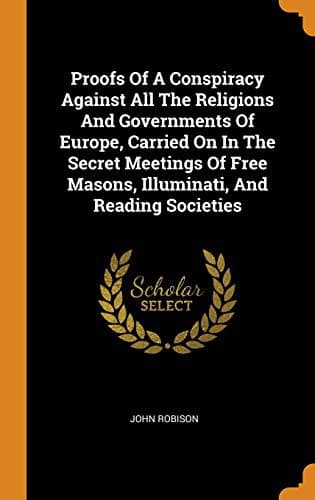
Proofs of a Conspiracy against all the Religions and Governments of Europe: carried on in the secret meetings of Free Masons, Illuminati, and reading societies.Robison, John
History
Proofs of a Conspiracy against all the Religions and Governments of Europe: carried on in the secret meetings of Free Masons, Illuminati, and reading societies.
Robison, John
Freemasonry -- Early works to 1800; Illuminati -- Early works to 1800
But it is quite uncertain when and why persons who were not
builders by profession first sought admission into this Fraternity.
The first distinct and unequivocal instance that we have of this
is the admission of Mr. Ashmole, the famous antiquary, in 1648,
into a Lodge at Warrington, along with his father-in-law Colonel
Mainwaring. It is not improbable that the covert of secrecy in those
assemblies had made them courted by the Royalists, as occasions
of meeting. Nay, the Ritual of the Master's degree seems to have
been formed, or perhaps twisted from its original institution, so
as to give an opportunity of sounding the political principles of
the candidate, and of the whole Brethren present. For it bears so
easy an adaption to the death of the King, to the overturning of the
venerable constitution of the English government of three orders by
a mean democracy, and its re-establishment by the efforts of the
loyalists, that this would start into every person's mind during
the ceremonial, and could hardly fail to show, by the countenances
and behaviour of the Brethren, how they were affected. I recommend
this hint to the consideration of the Brethren. I have met with
many particular facts, which convince me that this use had been
made of the meetings of Masons, and that at this time the Jesuits
interfered considerably, insinuating themselves into the Lodges,
and contributing to encrease that religious mysticism that is to be
observed in all the ceremonies of the order. This society is well
known to have put on every shape, and to have made use of every
mean that could promote the power and influence of the order. And
we know that at this time they were by no means without hopes of
re-establishing the dominion of the Church of Rome in England. Their
services were not scrupled at by the distressed royalists, even such
as were Protestants, while they were highly prized by the Sovereign.
We also know that Charles II. was made a Mason, and frequented
the Lodges. It is not unlikely, that besides the amusement of a
vacant hour, which was always agreeable to him, he had pleasure in
the meeting with his loyal friends, and in the occupations of the
Lodge, which recalled to his mind their attachment and services.
His brother and successor James II. was of a more serious and manly
cast of mind, and had little pleasure in the frivolous ceremonies
of Masonry. He did not frequent the Lodges. But, by this time, they
were the resort of many persons who were not of the profession,
or members of the trading corporation. This circumstance, in all
probability, produced the denominations of FREE and ACCEPTED. A
person who has the privilege of working at any incorporated trade,
is said to be a _freeman_ of that trade. Others were _accepted_ as
Brethren, and admitted to a kind of honorary freedom, as is the case
in many other trades and incorporations, without having (as far as
we can learn for certain) a legal title to earn a livelihood by the
exercise of it.
Public-domain text, read in full here on John Shaqi.
Reviews
Reviews
No reviews yet
Be the first to share your thoughts on this work.
Join the Discussion
Join the discussion
Sign in to leave a comment or review.
Sign InorCreate an account