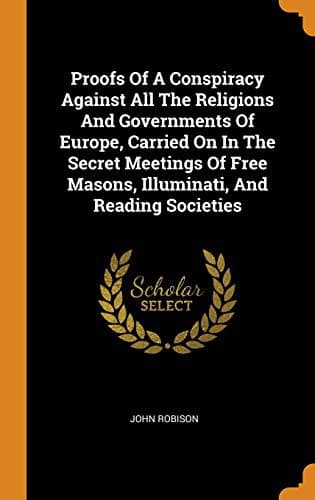
Proofs of a Conspiracy against all the Religions and Governments of Europe: carried on in the secret meetings of Free Masons, Illuminati, and reading societies.Robison, John
History
Proofs of a Conspiracy against all the Religions and Governments of Europe: carried on in the secret meetings of Free Masons, Illuminati, and reading societies.
Robison, John
Freemasonry -- Early works to 1800; Illuminati -- Early works to 1800
They were taught, that the great opportunities which the Superiors
had for observation, and their habits of continually occupying their
thoughts with the great objects of this Order, had enlarged their
views, even far beyond the narrow limits of nations and kingdoms,
which they hoped would one day coalesce into one great Society,
where consideration would attach to talents and worth alone, and
that pre-eminence in these would be invariably attended with all
the enjoyments of influence and power. And they were told that they
would gradually become acquainted with these great and venerable
Characters, as they advanced in the Order. In earnest of this, they
were made acquainted with one or two Superiors, and with several
Illuminati of their own rank. Also, to whet their zeal, they are now
made instructors of one or two Minervals, and report their progress
to their Superiors. They are given to understand that nothing can
so much recommend them as the success with which they perform this
task. It is declared to be the best evidence of their usefulness in
the great designs of the Order.
The baleful effects of general superstition, and even of any
peculiar religious prepossession, are now strongly inculcated,
and the discernment of the pupils in these matters is learned by
questions which are given them from time to time to discuss. These
are managed with delicacy and circumspection, that the timid may
not be alarmed. In like manner, the political doctrines of the
Order are inculcated with the utmost caution. After the mind of the
pupil has been warmed by the pictures of universal happiness, and
convinced that it is a possible thing to unite all the inhabitants
of the earth in one great society; and after it has been made out,
in some measure to the satisfaction of the pupil, that a great
addition of happiness would be gained by the abolition of national
distinctions and animosities; it may frequently be no hard task
to make him think that patriotism is a narrow-minded monopolising
sentiment, and even incompatible with the more enlarged views of the
Order; namely, the uniting the whole human race into one great and
happy society. Princes are a chief feature of national distinction.
Princes, therefore, may now be safely represented as unnecessary.
If so, loyalty to Princes loses much of its sacred character; and
the so frequent enforcing of it in our common political discussions
may now be easily made to appear a selfish maxim of rulers, by
which they may more easily enslave the people; and thus, it may at
last appear, that religion, the love of our particular country, and
loyalty to our Prince, should be resisted, if, by these partial or
narrow views, we prevent the accomplishment of that Cosmo-political
happiness which is continually held forth as the great object of
the Order. It is in this point of view that the terms of devotion
to the Order, which are inserted in the oath of admission, are
now explained.
Public-domain text, read in full here on John Shaqi.
Reviews
Reviews
No reviews yet
Be the first to share your thoughts on this work.
Elsewhere in the archive
Join the Discussion
Join the discussion
Sign in to leave a comment or review.
Sign InorCreate an account