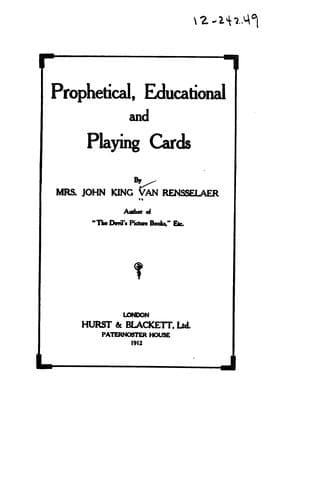
Prophetical, Educational and Playing CardsVan Rensselaer, John King, Mrs.
Religion
Prophetical, Educational and Playing Cards
Van Rensselaer, John King, Mrs.
Fortune-telling by cards -- History; Playing cards -- History
Under the name of Skat, and played with the pips of that country, a
modified form of the game is known in Germany. In Austria the game is
called Tappé Tarok, and the ancient names are assigned to strangely
designed cards quite foreign to the original Tarots, although the pack
includes twenty-two Atouts and fifty-two pip cards that bear the French,
but not the Italian or German, designs. For this game the old rules are
largely retained, and it is considered difficult and highly scientific, so
this rearranged pack has taken the place of the old Tarots in Austria.
Tappé Tarok is a fashionable game in Vienna, where the "Hoyle" of the day
calmly announces that it originated in that city with the cards invented
for it, totally ignoring the lineage of the true Tarots, of which their
Tarok pack is simply an alteration, with the French pips exchanged for
Cups, Money, Swords, and Staves. That the new symbols were adopted at the
same time that the emblematic figures of the Atouts were cast aside, to be
replaced by meaningless pictures, is most probable, and one author
declares that the change was made "lately," but a pack in the writer's
possession proves that such was not the case, for the designs are those of
the old Tarots.
After the fortune-telling pack had been adopted for a tête-a-tête game, it
spread rapidly from Etruria to other places, and L'Ombre is mentioned in
early Italian books of history, romance, and poetry, where the game is
frequently called Tarroco or Minchiate. In England the Poet-laureate
Waller immortalized "a card torn at L'Ombre by the Queen," who was
Catherine of Braganza, the wife of Charles II. It is Belinda's game in
"The Rape of the Lock," and in many pictures of that time players are
depicted either tête-a-tête, or else three persons are seated at
three-sided tables that were particularly fashioned for this game; these
are still treasured in old mansions, where they are called Ombre or
Preference tables.
The Spanish nickname for L'Ombre is Manilla, which is also that of one of
their favourite cards. Some of their towns have had this name given to
them, one of which is in the Philippine Islands and one on the African
coast. La Manilla is one of the "Matadores," the name given the four
cards that are selected to outrank all the others, and so called because
they are "killers" or "slaughterers," since they kill or take all other
cards.
The Ace of Espadas (Swords) is the first Matador, nicknamed Espadilla, or
little Sword, after the Harpé of Mercury that is represented on this card,
the suit being called after its emblem. In England the card is called
Spadille.
Public-domain text, read in full here on John Shaqi.
Reviews
Reviews
No reviews yet
Be the first to share your thoughts on this work.
Elsewhere in the archive
Join the Discussion
Join the discussion
Sign in to leave a comment or review.
Sign InorCreate an account