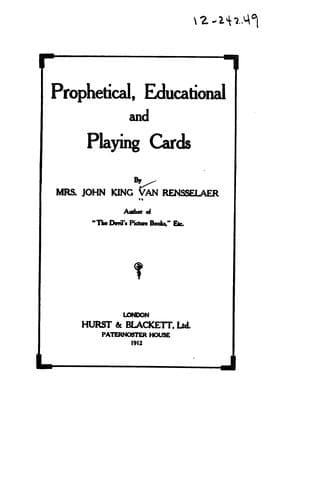
Prophetical, Educational and Playing CardsVan Rensselaer, John King, Mrs.
Religion
Prophetical, Educational and Playing Cards
Van Rensselaer, John King, Mrs.
Fortune-telling by cards -- History; Playing cards -- History
The second Matador is the one named Manilla or Malilla, and is the Nine of
Money. The third Matador is the Ace of Sticks, called Basto, "he who
knocks or beats." It is the Caduceus, or Rod, and the suit takes its name
from it. In certain parts of the game it is played with great effect, as
is mentioned in "Cranford," by Mrs. Gaskell, where is a description of
some ladies playing a game that was then called "Preference"; where Miss
Barker at the card table was "basting most unmercifully, although she
declared that she was too ignorant to know Spadille from Manille." The
fourth Matador is the Ace of Cups, and is called Punto, which means the
point or spot.
Players of Skat will readily recognize these terms and the value of the
cards. Rules and play vary in different countries, so it would take close
study of each game to point out the various rules, names, etc., that
connect the games of the day with their five-hundred-year-old ancestor.
In England the eldest descendant of L'Ombre seems to be Primero, Prime,
Prima-sta, or Preference, for all are the same game. Some writers claim
that when Philip of Spain was wooing Mary of England he taught her the
game fashionable at the court of his father, Charles V, but Primero was in
vogue among the people from the days of Henry VIII to that of James I, so
much so that Piquet, the French game taught to Henry's mother when the
French pips were introduced into England, was greatly neglected except in
court circles.
In the Earl of Northumberland's letters we find a reference to the game,
as in one of them is the following sentence: "Jocelyn Percy was playing at
Primero on Sunday in Essex House, when his uncle the conspirator called on
him."
In the Sidney Papers, Vol. II (page 83), there is an account of Sir Walter
Raleigh, William Ambrose Willoughby, and Mr. Parker "being at Primero in
the Presence Chamber, the queen was gone to bed. Lord Southampton, as
Squire of the Body, desired him, Willoughby, to give over. Soon after he
spoke to them again that if they did not leave he would call in the Guard
to pull down the board, which Sir Walter Rawley seeing put up his money
and went his ways." This occurred in 1598.
In Marcus's "Life at Primero," many of the terms used in the game are
mentioned, such as Prime, Rest, Eldest Hand, Flush, Stop, Pack, etc., all
of which have been adopted in one or more modern games. In Minshew's
Spanish Dictionary there is an illustration of players at Primero in the
time of Queen Elizabeth.
In "Capitolo del Gioco della Primera," by Berni, the game is thus
mentioned: "To describe what Primera is would be little less than useless,
for there can scarcely be any one so ignorant as to be unacquainted with
it, although played differently in Florence from Venice, Naples, France,
or Spain, but none of these various ways of playing the game are superior
to the Rules of Rome, where the game principally flourishes."
Public-domain text, read in full here on John Shaqi.
Reviews
Reviews
No reviews yet
Be the first to share your thoughts on this work.
Elsewhere in the archive
Join the Discussion
Join the discussion
Sign in to leave a comment or review.
Sign InorCreate an account