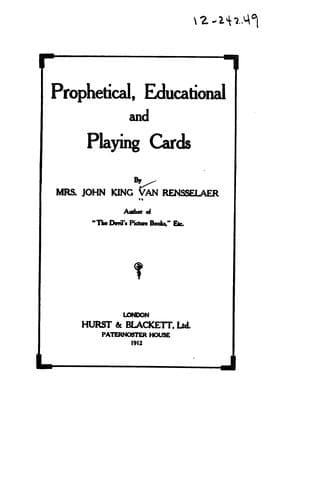
Prophetical, Educational and Playing CardsVan Rensselaer, John King, Mrs.
Religion
Prophetical, Educational and Playing Cards
Van Rensselaer, John King, Mrs.
Fortune-telling by cards -- History; Playing cards -- History
In one of the works of Rabelais, edited by M. le Duchat, two kinds of
Primero are described called "the lesser" and "the greater." In the former
only pip cards are required, but in the latter the whole Tarot pack is
retained, as in Austria, where Atouts and pip cards belong to Tappé Tarok.
The Germans play "the lesser Primero" and call it Skat. This shows how
widely the rules of the game have parted from the original laws, which is
the reason that it is now almost impossible to harmonize it with the
fortune-telling game that it was primarily. In Italy it is called
Minchiate, Tarocco, and Tarocconi. These now differ as much from the
original as bridge whist does from these games.
The terms of the different games were frequently used in old plays or
romances in England, as well as in other places. Shakespeare mentions
Primero in "Henry VIII" (v:1): "I left the king at Primero with the Duke
of Suffolk." Again, in "The Merry Wives of Windsor" (iv:5), Falstaff says:
"I never prospered since I foreswore myself at Primero."
Sir Harry Wildair (1701) says: "The Capot at Piquet, the Paroli at Basset,
and then Ombre. Who can resist the charms of Matadores?"
Lady Lurewell answers: "Ay, Sir Harry, and the 'Sept le va, Quinze le va'
[of Basset], 'the Nine of Diamonds at Comet' [or Pope Joan], 'three Fives
at Cribbage and Pam,' the 'Queen to the Knave of Clubs in Loo.'"
The terms in Primero have been so generally adopted in modern games that
they are familiar to all players, although as a collection they are no
longer used for one game. Primero is played by dealing four cards, at
which the players look, and, if they are unsuitable, they say "Pass." The
Sevens are the highest cards and are worth twenty-one points. The other
numbers have values that differ according to the locality where the game
is played. Quinola, or the Knave of Hearts, represents the Joker, and the
cards left after dealing are not called the Widow or the Stock, as in some
games, but the Rest. Punto, or "point," is not the Ace of Cups, as in
Spain, for in England it is the Quinola. Flushes are four cards of the
same suit, and Prime is a hand in which there are four cards of the same
value, but each one of a different suit.
Card games followed each other, first one and then another becoming the
fashion, only to be replaced by a new one or a modification of some old
one, and after L'Ombre and Preference came Mawe, Post, Lodam, Noddy,
Barkerout (probably Baccarat), and countless others, to the now
all-important Bridge or Auction Whist.
Public-domain text, read in full here on John Shaqi.
Reviews
Reviews
No reviews yet
Be the first to share your thoughts on this work.
Elsewhere in the archive
Join the Discussion
Join the discussion
Sign in to leave a comment or review.
Sign InorCreate an account