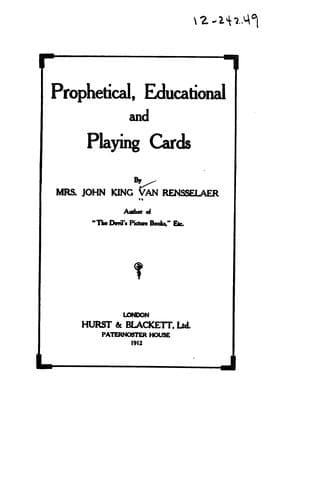
Prophetical, Educational and Playing CardsVan Rensselaer, John King, Mrs.
Religion
Prophetical, Educational and Playing Cards
Van Rensselaer, John King, Mrs.
Fortune-telling by cards -- History; Playing cards -- History
In Persia, where only the Atout or figure part of the pack is used, while
the pip part is omitted, the figures are painted in harmonious colours and
it is left for the tints of the background to indicate the suits. In the
Kile Kort or Cucu pack of Sweden (which also has figures) there are no
colours whatever, but the designs are printed in black ink on white
cardboard. This is also the case with old cards from the Netherlands, but
none of these packs were ever intended for fortune-telling.
There have been many persons who have interested themselves in the history
of playing cards, and some of them have pierced the veil surrounding their
cradle; but, generally, since these students have only been interested in
the cards as toys or gambling instruments or as rare specimens of
painting, engraving or stencilling, the studies have not extended beyond
the time when playing cards became common in Europe, or about the
beginning of the fourteenth century. None of these students followed the
clues that would have proved the original purport of the "tablets of
fate."
In "Les Etudes Historique sur les Cartes à Jouer," by M. C. Leber (1842),
the question is asked: "Where do cards come from, what are they and what
do they say?" These queries the writer proceeds to answer only in part,
for he fails to see the connection of the cards familiar to him, that have
French or German pips, with the more ancient Tarots, which, in all
probability, he had never seen. But Leber states positively that cards
"are of ancient origin and Eastern invention, and primarily they
constitute a symbolic and moral game." He professes to be guided by the
emblems on the cards themselves, but he fails to decipher or to understand
the evidences shown by the heraldic devices peculiar to one of the ancient
Greek gods, which would have answered his questions.
According to the Rev. Edward Taylor and other authorities, the emblematic
and mystic cards called Tarots were "born long since in the East, from
whence they were brought by the gypsies for thaumaturgic purposes."
Although it is declared that the gypsies always carried and consulted
packs of cards ever since the wanderers were known in Europe, these people
themselves have no history of their mystic book that they will disclose,
so the positive historical record of playing cards as used for gambling
games or fortune-telling does not commence before the second half of the
fourteenth century.
These cards are the ones we call Tarots, which are still common in Italy,
and the emblems on the cards themselves reveal their original connection
with the worship of Mercury in Etruria, of Thoth in Egypt, and of Nebo in
Babylonia. These three gods have the same attributes, and were worshipped
for many generations in the then civilised portions of the world; yet the
forms of their worship, that have been so strangely transmitted to us
through the greatest of their books, the cards are now little understood
and seldom consulted.
Public-domain text, read in full here on John Shaqi.
Reviews
Reviews
No reviews yet
Be the first to share your thoughts on this work.
Join the Discussion
Join the discussion
Sign in to leave a comment or review.
Sign InorCreate an account