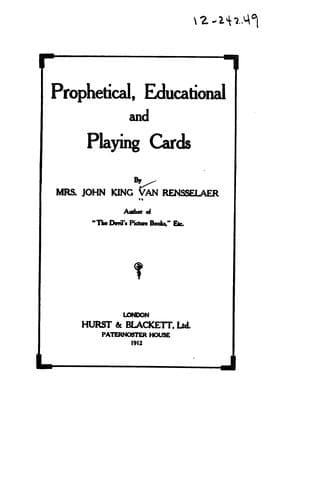
Prophetical, Educational and Playing CardsVan Rensselaer, John King, Mrs.
Religion
Prophetical, Educational and Playing Cards
Van Rensselaer, John King, Mrs.
Fortune-telling by cards -- History; Playing cards -- History
Indeed, the very name Tarot has been deemed by some authors as positive
proof that the cards are the unbound leaves of one of the great books of
the Temple of Thoth Hermes Trismegistus, since they derive the word Tarot
from Thoth or else from Thror Tahar, which, says Wilkinson (Volume II,
page 90), "were the parchment records kept in the Temple, which are
mentioned in the time of the eighteenth dynasty that were written on
skins." The same author states (page 207) that "Thoth framed the laws." In
fact, his temple was the seat of all learning, where doctors, lawyers and
scientists were able to study and to devote their knowledge to the god
they worshipped.
It seems, therefore, that the name is in truth one of the links in the
chain of evidence proving that what we use as playthings were once part
of the great cult of Mercury and his African or Asian _confrères_, in
whose time the pictures and the emblems were thoroughly understood and
were regarded with awe or reverently consulted, since by their means alone
could the wishes of the gods be made known to mortals, through the medium
of the priests of Mercury, Thoth, or Nebo.
The intimate connection of the triple god is no fanciful suggestion, but
is acknowledged by all students. Nebo, of the Babylonians (mentioned in
the Bible), Thoth, of the Egyptians, and Hermes, of the Greeks, were all
worshipped as gods of speech and inventors of transmitted ideas. It is not
credible that in Asia or Africa, even as early as the twelfth dynasty,
that voice language or speech was a gift newly granted to mankind, so
there must have been some reason for the belief that "these gods gave
speech to mankind." This is one of the superstitions puzzling many modern
students who have tried to investigate the mysteries of the Temple of
Thoth.
It is now believed that one of the priests who was connected with the cult
conceived the bright idea of communicating the wishes of the planets, of
the vegetable and the animal kingdoms, as well as those of the patron
gods, to mankind through a well-arranged system that had the Temple of
Thoth for a centre and its priests as interpreters. The power that this
system would give to the learned men congregated in the vast Temple of
learning would be great, and would increase their prestige to a wonderful
extent. Before that time the primitive people were content with simple
means of consulting the wishes of the gods, or with the decrees written at
the birth of each child on the tablet of fate by "the writer of Esigalia,
who was called Nebü." The means generally resorted to were those still
common in Korea, Japan and China, where the oracle is consulted by
throwing a handful of sticks before a shrine. Among the Arabs a sheaf of
arrows is used. Gordon Cummings describes his negro servants using sticks
which were marked and then thrown on the ground, when the natives desired
to be told by their gods where the game lay and what direction to take
when hunting.
Public-domain text, read in full here on John Shaqi.
Reviews
Reviews
No reviews yet
Be the first to share your thoughts on this work.
Join the Discussion
Join the discussion
Sign in to leave a comment or review.
Sign InorCreate an account