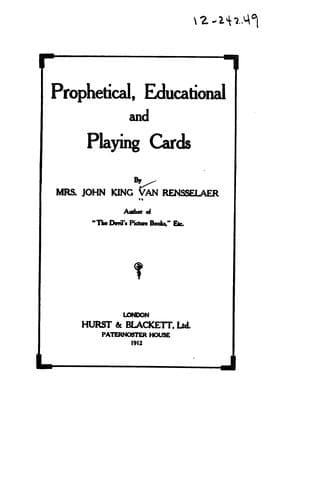
Prophetical, Educational and Playing CardsVan Rensselaer, John King, Mrs.
Religion
Prophetical, Educational and Playing Cards
Van Rensselaer, John King, Mrs.
Fortune-telling by cards -- History; Playing cards -- History
Some are very primitive in their markings; others closely resemble
dominos, having similar spots on them denoting their value; while the
cards in common use have distorted emblems that are clearly derived from
the Sword, Stave, and Money pips of the Tarots, although the Cup of Hermes
is not retained. It is noticeable that the Money emblem has a design upon
it, and is not the simple ring of primitive times. This leads to the
suggestion that these particular cards were devised from those of Mercury.
Since there are Court cards and a Joker, it would seem as if the Chinese
had adopted part of a pack of Tarots, omitting the Cup suit, since it had
no meaning for them, but copying the other emblems in their own peculiar
way; but this is only a guess as to the origin of this particular set of
cards, and only those used for divination bear these devices.
The Chinese also have Actors' cards, bearing portraits of the heroes and
heroines of certain favourite plays. These have three Jokers, that in
China bear the name of "Blessings." Then there are flower packs and
educational packs, Proverb cards, and cards to teach writing, so that the
Chinese have in their own original way marched step by step with
Europeans, but on parallel lines that have not met. The Chinese declare
that they have known and used Playing Cards for two thousand years, in
which statement they are probably correct, as certainly the Rod, the
Sword, and Money emblems were known and used by the Babylonians in their
religious rites two thousand five hundred years before Christ.
Owing to cards having been introduced into Japan by Portuguese traders,
the packs are called by the Portuguese name of Karta, as has been
mentioned. But the resemblance to European cards stops there, for the
"shut-in nation" invented designs and games for themselves, keeping them
distinct from divining instruments, of which they have a full share, some
of them being identical with the Chinese rods for divination.
One Japanese game is historical, and the packs are beautifully painted in
miniature, with gold backgrounds and gold backs. The cards are three by
three and a half inches in size. Two sets always come in one box, and the
game is played by matching cards. They far surpass European ones, for they
are most carefully designed and painted. The two sets in the writer's
possession resemble dainty miniatures, and the small figures might almost
be taken for likenesses of living people.
Then there are other sets of cards of the same size as those described,
but differently marked, as they have three suits indicated by the colour
of the emblems, blue, green, and red. There are two emblematic Court
cards, one of them the picture of a house, the other one showing a stream
over which a bridge is thrown. The pack in the writer's collection is
rare, for none like it has been described, and there are none in the
foreign museums.
Public-domain text, read in full here on John Shaqi.
Reviews
Reviews
No reviews yet
Be the first to share your thoughts on this work.
Elsewhere in the archive
Join the Discussion
Join the discussion
Sign in to leave a comment or review.
Sign InorCreate an account