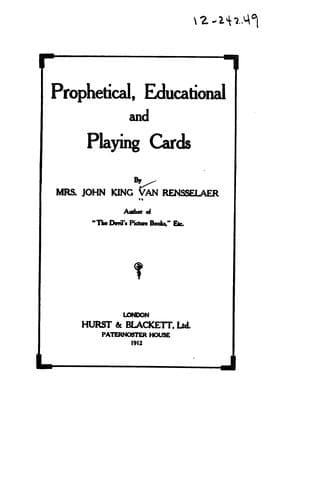
Prophetical, Educational and Playing CardsVan Rensselaer, John King, Mrs.
Religion
Prophetical, Educational and Playing Cards
Van Rensselaer, John King, Mrs.
Fortune-telling by cards -- History; Playing cards -- History
Another set of cards is called Bakuchi-No-Euda, or gambling cards. Those
in common use are of cardboard about two to two and a quarter inches
square, with black backs and flowers painted or stencilled on them,
representing the weeks of the year. The game played with them is called
"flower matching." January is represented by a Matsu or Pine tree,
followed by the Plum, Cherry, Wistaria, Iris, Peony, and Clover. The
eighth suit has a sketch of a volcano, representing August, which is the
sacred month; during it pilgrimages are made to the mountain. The card
which follows represents a Chrysanthemum; then comes a Maple for October.
November is represented by rain, sometimes with a little man scampering
through the driving storm with a half-opened umbrella over his head, his
shoes flying off in the mud, with the symbol of thunder and lightning
placed in one corner of the card. December has the flower sacred to the
Mikado, the Kiri.
Each card shows the flower representing it in different stages of
development, according to the four weeks in the month. Each has a definite
value, and the game is played by three persons, who match cards to make
different combinations. The Joker is blank, so these cards were never
intended for divining, but were prepared solely for amusement.
Divining arrows, represented by bamboo splints, are used in Japan as well
as in China, and are nearly identical in both countries. Fifty sticks are
kept in a quiver or a tube of cane, resembling the shape of the modern
dicebox. "The splints vary in length," says Mr. Culin, who describes them
in "Korean Games" (page 26), "from two to four inches." One person
consults the oracle, which is interpreted by a "Baru," or fortune-teller,
as described in "Our Neighbourhood," by Mr. Purcell: "Having rattled his
rods together by rolling them between his palms, he raises them to his
forehead." The sticks are then laid out in order on a table, and their
meaning is deciphered through referring to the "Book of Oracular
Responses," or through the "inspiration of the magi, who declares that he
passes one hour daily in a trance, during which he receives instruction as
to the prognostication he must deliver."
Public-domain text, read in full here on John Shaqi.
Reviews
Reviews
No reviews yet
Be the first to share your thoughts on this work.
Elsewhere in the archive
Join the Discussion
Join the discussion
Sign in to leave a comment or review.
Sign InorCreate an account