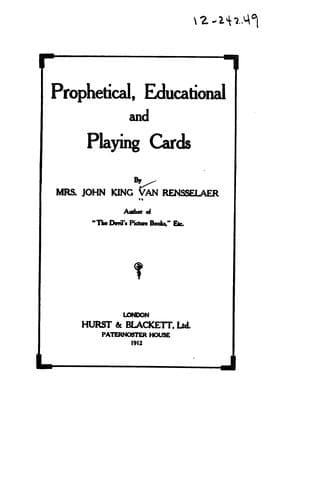
Prophetical, Educational and Playing CardsVan Rensselaer, John King, Mrs.
Religion
Prophetical, Educational and Playing Cards
Van Rensselaer, John King, Mrs.
Fortune-telling by cards -- History; Playing cards -- History
There is another Japanese game called Hayku-Niu-Isshu, or the Poems on One
Hundred Arts. For this there are two hundred cards, that are kept in boxes
especially provided for them. On each card is printed or written either
the first or the last half of one of the hundred poems that give their
name to the game, which all well-educated Japanese are supposed to know
by heart. "The one hundred cards having the latter half of the poems
written on them are dealt and are laid out in rows, face upwards, before
the players, one of whom is appointed reader. He holds the remaining
hundred and reads them aloud in whatever order they fall. Skill in the
game consists in remembering the line following the one read and rapidly
finding the card on which it is written. Especially must each one watch
his own and pick it up before it is seized by another. If an opponent is
nimble he snatches the card from the careless player, giving several from
his own hand, and the one who is first able to match and discard all of
his cards wins the game. The players usually range themselves on opposite
lines and play against each other." Such is the account of the game given
by Miss Alice Mabel Bacon in "Japanese Girls and Women" (page 22).
The cards of this set in the author's possession are rather small, being
two by two and a half inches, or a trifle larger than the Flower pack.
They are arranged in small wooden boxes, with a description of the rules
of the game printed on the top; the lid moves up and down in a groove.
The verses are written in fine running characters on a white ground.
In Hindustan we find strange circular cards that have strayed far from the
arrow shape, and seem much more to resemble the European pips. There are
eight suits, indicated by the colour of the background, on which are
depicted Men, Bullocks, Elephants, and Tigers. The Money and Cup suits may
be traced in two of the emblems, the former painted like a double ring,
and it is questionable if these cards were ever intended for divining
purposes, since they seem to be used purely for amusement.
Persian cards are about two inches by one and a half square. The suits are
shown, like those of Cashmere, by the colours of the background. They have
nothing in common with the arrow-shaped Korean, Chinese, or North American
divination cards, but rather incline to the emblematic figures of the
temple of Thoth as retained by the Tarots, for every card displays a
symbolic representative figure. These cards are rare even in Persia, and
only two incomplete sets are in the writer's collection, one of which
contains six, and the other eighteen, cards.
Public-domain text, read in full here on John Shaqi.
Reviews
Reviews
No reviews yet
Be the first to share your thoughts on this work.
Elsewhere in the archive
Join the Discussion
Join the discussion
Sign in to leave a comment or review.
Sign InorCreate an account