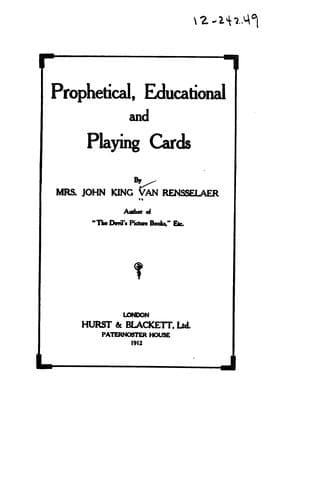
Prophetical, Educational and Playing Cards — John Shaqi
Prophetical, Educational and Playing CardsVan Rensselaer, John King, Mrs.
Religion
Prophetical, Educational and Playing Cards
Van Rensselaer, John King, Mrs.
Fortune-telling by cards -- History; Playing cards -- History
Many links in the chain connecting playing cards with the ancient
mysteries can be separately taken up and studied. In the first place, the
histories of Mercury show him as being worshipped under several distinct
attributes, combined with that of being the Interpreter or Messenger of
the gods, and the students who were of his cult learned twenty or more of
the arts and sciences which Thoth or Mercury was supposed to have
invented, such as speech, music, painting, agriculture and astronomy, all
of which were under his protection. Virtue, vice, death, temperance,
health, joy and sorrow each had an emblematic figure peculiar to and
connected with it, such as a hanged man or a skeleton. Each of these
figures, if displayed on the walls of a temple could be recognised even by
an unlettered congregation, so the people would have been accustomed to
these representations, even after they were removed from the walls to the
flat surface of the cards and no longer displayed in their exalted
positions.
The emblematic figures found on the Tarots and called the Atouts are still
known by the names given to them when the Egyptians introduced them to
Europe, and are as familiar in Italy to-day as when worshipped under the
protection of Mercury. After a little study the attributes displayed on
the modern Tarots show most plainly their Egyptian origin, and mutely
declare their pedigree--the image, value and position of each card,
unchanged for ages, all silently pointing to this. Yet, while strangely
conforming to all the attributes, decorations and posture of the gods as
represented in the Egyptian temples, the designs have been so modernised
as to be at first difficult to recognise.
It is supposed by several authors, notably by Court de Gebelin, as early
as 1773, when he published "The Primitive World," that originally the
twenty-two figures of the Atout or emblem part of the Tarots were painted
on the walls of the temples, a fashion inherited from Biblical times, to
enable the worshippers to recognise gods, sciences, arts or conditions
represented by the figures and their attributes when it was wished to
consult them. Discoveries in Babylonia and Egypt since De Gebelin's time
have confirmed his suppositions.
These figures in themselves were insufficient for communicating with the
gods, for they were speechless, so for the purpose of transacting business
with them the second volume of the book of Thoth was adopted by taking
from the peasants their ancient fashion of consulting the gods through the
throw of arrows or rods. These were marked with figures representing a
father, a mother, a child and a servant, and four tokens or heraldic
devices were also scratched on the rods, dividing them into the suits
that have been so universally retained. These symbols were always
connected with the worship of the gods, and ivory rods bearing these
devices have been found in the tomb of King Qa, who is supposed to have
lived about 4000 B. C.
Public-domain text, read in full here on John Shaqi.
Reviews
Reviews
No reviews yet
Be the first to share your thoughts on this work.
Join the Discussion
Join the discussion
Sign in to leave a comment or review.
Sign InorCreate an account