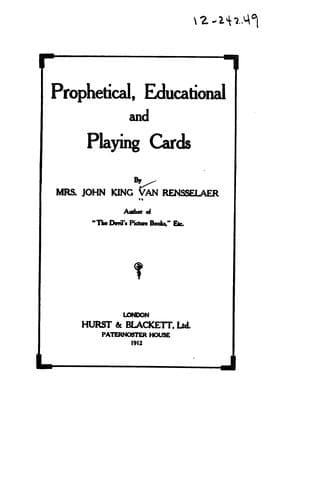
Prophetical, Educational and Playing Cards — John Shaqi
Prophetical, Educational and Playing CardsVan Rensselaer, John King, Mrs.
Religion
Prophetical, Educational and Playing Cards
Van Rensselaer, John King, Mrs.
Fortune-telling by cards -- History; Playing cards -- History
It is quite evident in the first place that the Staff, or magic wand, must
have been inspired by the caduceus, or, perhaps, by the stylus, which is
also emblematical of Thoth and was used by the Babylonian god Nebo to
write on his tablets of fate. The Sword was derived from the Harpé
presented by Jupiter to his son, Mercury, and was also used by Nebo. The
purse of Money, and the Chalice, have from the earliest times been
connected with spiritual uses and the mysteries of the three prophetical
gods. Any one of the four denoted Mercury, while not one of the other gods
of Olympus, Babylonia, or Egypt was ever so marked, and none of them
combined all the sciences and arts that were practised by his priests and
dedicated to the honour of the god who was worshipped as the prophet and
messenger from gods to men.
The connection of the Tarot cards with astronomy and astrology is a study
by itself, but, since these sciences were part of the course of studies
pursued by the priests of Thoth, many emblems connected with them are
found on the Atouts. These had meaning for those learned enough to read
the signs. But each Atout, be it connected with kabbalism, demonology,
Babylonian, Egyptian, Greek or Roman mythology, is written in a language
now partly forgotten, but once widely known and revered.
At first the book of Thoth, or prophetic cards, was only in the hands of
the priests; but as the meaning of these detached leaves was from time to
time revealed to the educated classes, these persons learned to consult
the Tarots for themselves when desiring to know the wishes of the gods. A
systematic arrangement of the cards could be made by a couple of players,
and this tête-a-tête method of asking for divine guidance is a very
ancient custom, and must receive due recognition when studying the cult of
Mercury, for it must be particularly noted that all the earliest known
games with cards are invariably for two persons and two only, so that when
more players were added to the game its name was altered.
It will be recalled how many times magical performances are mentioned in
the Bible, one of the most notable being in Numbers xxii, when Balak
consulted Balaam. The whole ceremony is there graphically described, but
these two men were the only ones who took active part in the ceremony,
although Balak sent "the elders of Moab and the elders of Midian to Balaam
with the rewards of _divination_ in their hands." By some people it might
be supposed that Balak intended to bribe Balaam for a favorable report
from his god, but "When Balaam saw that it pleased the Lord to bless
Israel, he went not, as at other times, to seek for enchantments" (Numbers
xxiv:1). The whole history of the occult transaction shows that these two
men alone took part, although others stood aloof and watched from afar.
Public-domain text, read in full here on John Shaqi.
Reviews
Reviews
No reviews yet
Be the first to share your thoughts on this work.
Join the Discussion
Join the discussion
Sign in to leave a comment or review.
Sign InorCreate an account