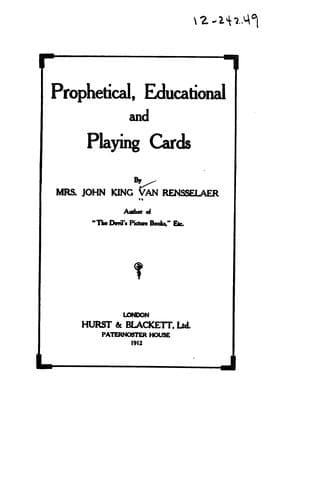
Prophetical, Educational and Playing CardsVan Rensselaer, John King, Mrs.
Religion
Prophetical, Educational and Playing Cards
Van Rensselaer, John King, Mrs.
Fortune-telling by cards -- History; Playing cards -- History
Prof. Samuel Daiches, in his essay, "Balaam a Baru," declares that "Balaam
was a sorcerer pure and simple," quoting from certain Babylonian tablets
written in cuneiform characters, to prove his resemblance to the "baru" of
the ancient ritual who would be deemed a magician in these days. Professor
Daiches also states that, in the Babylonian Ritual Tablets lately
deciphered, is found the statement that "the diviner and the inquirer in
the ceremony have _both_ to be engaged and present when the wishes of the
gods are to be consulted," and that "this was followed in religious
ceremonies in many other countries." This custom is adhered to at present
in the Roman Catholic Church when the penitent confesses to the priest,
the two people being alone and shielded from observation.
All the early games for the Tarots were arranged for two persons. The
modifications that crept in after 1400 allowed other players to join, when
different names were given to the newly invented games. The main rules
were but little altered and the play was only changed in order that others
might take part, which is one of the clearly defined marks indicating the
period when the Tarots were discarded by initiated persons and adopted by
people in general, who accepted the cards for amusement, leaving the
prophetic mysteries to the superstitious. The complete pack of Tarots, as
it came from the ancients, consists of two parts, twenty-two Atouts and
fifty-six suit cards, or seventy-eight in all; but these are used only in
Italy.
A pack called Tarok or Taroc is a favorite in Austria and Hungary, though
unknown elsewhere, a fact of which the Viennese are inordinately proud,
for they declare, and with truth, that their game is scientific and
requires keen intellects to play it successfully. But their handbooks on
the game do not recognise the fact that their cards are copied from the
ancient Book of Thoth, and that their game is almost identical with the
original one of divination called "L'Ombre." The Austrian Taroks have the
same numbers as the originals, and retain twenty-two Atouts, but only "le
Fou" or "Mercury" has an emblem resembling those on the old leaves. The
designs have within fifty years changed from the German or Italian pips to
the French devices of Coeurs, Carreaux, Trifle and Piques.
Public-domain text, read in full here on John Shaqi.
Reviews
Reviews
No reviews yet
Be the first to share your thoughts on this work.
Join the Discussion
Join the discussion
Sign in to leave a comment or review.
Sign InorCreate an account