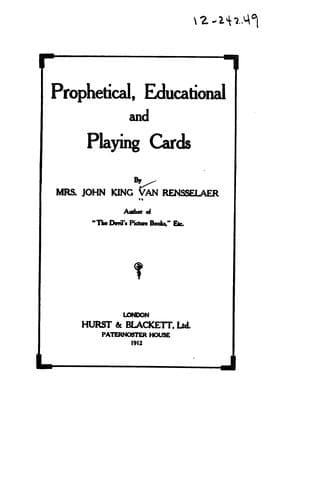
Prophetical, Educational and Playing CardsVan Rensselaer, John King, Mrs.
Religion
Prophetical, Educational and Playing Cards
Van Rensselaer, John King, Mrs.
Fortune-telling by cards -- History; Playing cards -- History
Pasmmetichas, king of Sais, who, as has been already mentioned, fought the
Assyrians, must have been a most intelligent person, for during his reign,
says Mr. Rawlinson (page 465), "a question was raised as to the relative
antiquity of different races of mankind. Therefore the Pharaoh had two
children isolated from their species and brought up by a herdsman who was
dumb, and suckled by a goat, in order to see what language they would
speak, presuming that they would revert to the primitive type of speech.
The result of his experiment was thought to prove the Phrygians to be the
most ancient nation, and the Egyptians, we are told by Herodotus, accepted
it as an established fact."
Thoth was revered as a great teacher, since his works treated of all
things, such as the creation of the world, of divine power, of wisdom, of
the art of presaging the issue of maladies by means of the planets. The
work treating on this was dedicated to Ammon. Then there were the
Aphorisms of Hermes, which consisted of astronomical propositions
translated from the Arabic about the time of Manfred, king of Sicily. "The
Cyranides of Trismegistus" treats of magic power and the medicinal virtues
of precious stones, of plants, and of animals. Many of the other books of
Thoth are treatises on chemistry or alchemy. One is called "The Seven
Seals of Hermes Trismegistus," another, "Chemical Tinctures," and a third,
"The Emerald Tablet," describing the art of making gold. It is said that
Sara, the wife of Abraham, found the Emerald in the tomb of Hermes, on
Mount Hebron. One essay is to Tat or Esculapius, another is entitled "The
Virgin of the World," as Isis is sometimes called, and is a dialogue
between her and her son Horus.
Many small statues were found in a well in the temple of the Sphinx, that
may have originally represented the gods now found among the Atouts. This
would be a most valuable confirmation of the theory of their original
position in the temple when the priests and initiates wished to consult
the occult.
In an age when letters were only used by the learned, and pictured emblems
or symbols took the place of an alphabet, it was natural that the priests
of Thoth, when pressed to divine the fate of men, should place sketches of
the great gods on the walls of their temples, so that, by combining them
with the rods of divination, the wishes of the supreme beings could be
easily conveyed. The custom of adorning the walls of the temple is
referred to in Ezekiel xxiii:14. "She saw men pourtrayed upon the wall,
the images of the Chaldeans (or Nebo and his confrères) pourtrayed with
vermilion, girdled with girdles upon their loins, exceeding in dyed attire
upon their heads, all of them princes to look to, after the manner of the
Babylonians of Chaldea." This was possibly the origin of the Tarots, or
the Atout volume of the Book of Thoth.
CHAPTER V
NEBO, OR NABU
Public-domain text, read in full here on John Shaqi.
Reviews
Reviews
No reviews yet
Be the first to share your thoughts on this work.
Join the Discussion
Join the discussion
Sign in to leave a comment or review.
Sign InorCreate an account