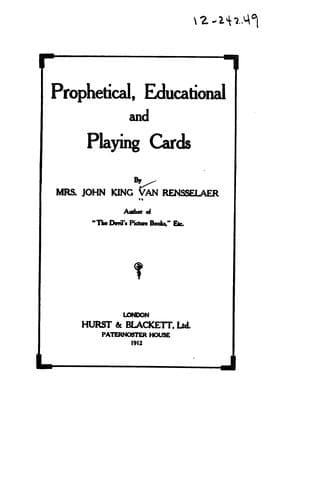
Prophetical, Educational and Playing Cards — John Shaqi
Prophetical, Educational and Playing CardsVan Rensselaer, John King, Mrs.
Religion
Prophetical, Educational and Playing Cards
Van Rensselaer, John King, Mrs.
Fortune-telling by cards -- History; Playing cards -- History
A great Chaldean god was Nebo, mentioned in Isaiah xlvi:1, "Bel boweth
down, Nebo stoopeth," and he had an immense influence over the lives of
the Assyrians and Babylonians, extending over centuries. In primitive
times nothing was undertaken without an attempt to consult the wishes of
the superior gods, and it is interesting to trace through the tablets on
which are inscribed the wonderful cuneiform inscriptions, discovered and
deciphered during the past fifty years, how the people were taught by
their prophets or priests to consult the predestinations of Nebo, who
inscribed at birth what would befall each person during life. Nebo had
many names or designations. He was called Laghlaghghi-Gar, or illuminator;
Gishdar, or god of the sceptre; Ilu-tashmit, or god of revelations; and
the spouse of Tashmit; his name signifies Proclaimer Herald in Assyrian,
and Height in Hebrew.
Nebo, called Nabu by the Babylonians, was the son of Enlil, or Marduk, the
Merodach of the Bible (Jeremiah l:2), who became merged in the Jupiter of
the Romans. Nebo was the husband of Tashmitum, or Tashmit, or Tashmetu,
sometimes called Erna. Her name is translated as signifying "revelation,"
"she who listens," or "she who intercedes." She is frequently invoked and
besought to placate her more important spouse, or she is appealed to by
worshippers to intercede with her consort to reveal what he had prophesied
on the "tablets of fate."
As the grandson of Ea, who was the god of doctors, Nebo inherited the
privileges of healing. He also presided at birth and death, and could cure
diseases. One of his symbols seems peculiar and is still retained on the
Tarots. It is a sword, for in the minds of the men of his day a pestilence
was a certain follower of war. Although Nebo was not the god of war, he
was first its herald and then the healer of the sick or wounded, so it was
under these conditions that a sword became his attribute.
Nebo shared with Shamash, Gula, and Nergal of Assyrian mythology, the
power of restoring the dead to life, which, being interpreted, means
curing the ill, whether from disease or sin.
It was to Nebo that the Assyrian kings ascribed their wisdom, for he was
deemed to be the source of all knowledge, and the wonderful inventor of
the art of writing that enabled the wise men who were his priests to
preserve the records of the different reigns and the history of wars, the
description of buildings and their donors, of deeds of valour and of
charity, for the enlightenment of posterity.
The great temple built at Calah in the time of Ram-man-nerari III (812-783
B. C.) is inscribed with a dedicatory inscription placed by the king on
the statue of Nebo. It closes with the sentence:
"Oh! posterity, trust in Nabu,
Trust in no other god."
Public-domain text, read in full here on John Shaqi.
Reviews
Reviews
No reviews yet
Be the first to share your thoughts on this work.
Join the Discussion
Join the discussion
Sign in to leave a comment or review.
Sign InorCreate an account