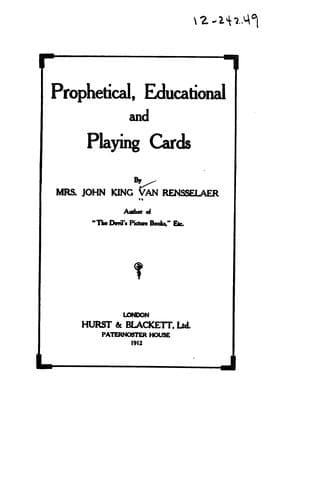
Prophetical, Educational and Playing CardsVan Rensselaer, John King, Mrs.
Religion
Prophetical, Educational and Playing Cards
Van Rensselaer, John King, Mrs.
Fortune-telling by cards -- History; Playing cards -- History
This card, also known as the Juggler or Pagat, bears various names,
according to the locality where it was used. "It is derived," says Count
Emiliano di Parravicino, in the _Burlington Magazine_ for December, 1903,
"from Bagat or Paghead and Gad, that signifies fortune, and the card is
often called Bagatto (or cobbler), since there are sometimes tools placed
on the board in front of the figure, one of which (in the corrupted
designs of modern cards) resembles a cobbler's awl." The figure on this
card represents the Player or Inquirer, and when the cards are laid out,
according to the rules of prophesying, it is controlled by all that are
dealt close to it. That is to say, the cards surrounding this figure tell
the events that are likely soon to befall the inquirer. The first Atout
represents a young man standing behind a table. On his head is a hat of
mystic meaning, for it is shaped like the sign of "eternal life,"
[Illustration: infinity symbol]; his left hand carries a wand, called by
de Gebelin "_son Bâton de Jacob, ou Verges des Mages_." This magician's
wand was readily recognized by the shrewd Frenchman, who evidently
understood the symbolism of the rod of Aaron (or Jacob). The rod is really
the caduceus of Mercury that has so many significances. It is one of the
pip devices that has been reproduced in the Ace of Rods, Staves, or
Sceptres, as it is variously called, and, by placing it in the hand of the
inquirer, it denotes that he has been given the power to consult the
oracle. The other articles placed on the table before the youth are the
other devices that mark the suits of the cards, namely: Money, Cups and
Swords, although on modern Italian Tarots these emblems are often changed
for others that lack significance. In "the lottery chart," called
Tsz-fa-to, used by the Chinese fortune-tellers, there is a figure like the
Bagatleur, holding up his hand in the same way, which recalls the many
mystic meanings attached to the "blessing hand." The Pagat or Magician (as
this card is often called) is sometimes expressed merely by the Hebrew
letter Aleph, which is placed beside the figure, or is used alone, when an
Initiate understands the symbol as well as if the Pagat was in its place.
What relation the Hebrew alphabet has to the Tarots is a matter for
conjecture, but the characters are often placed on early packs, and some
writers have pointed out that, in their opinion, these letters offer fresh
evidences of the origin of cards and their connection with divination. So
Papus says: "The first letters of the alphabet express hieroglyphically
man himself as a collective unity--the Master principle--the ruler of the
world." In very old packs the earth is represented at the bottom of the
picture, ornamented with its fruits. The centre is occupied with the man,
whose right hand bent towards the ground, the left hand raised towards
heaven, thus representing two principles, the one active and the other
Public-domain text, read in full here on John Shaqi.
Reviews
Reviews
No reviews yet
Be the first to share your thoughts on this work.
Join the Discussion
Join the discussion
Sign in to leave a comment or review.
Sign InorCreate an account