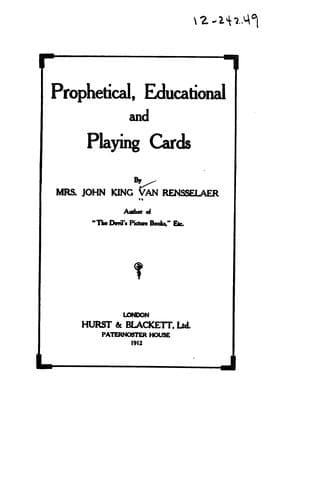
Prophetical, Educational and Playing CardsVan Rensselaer, John King, Mrs.
Religion
Prophetical, Educational and Playing Cards
Van Rensselaer, John King, Mrs.
Fortune-telling by cards -- History; Playing cards -- History
passive, of the great All, and it corresponds with the two columns of
Jakin and Bohas of the temple of Solomon and of Freemasonry, as well as
with the great statues erected before the tombs of the Egyptian kings. The
meaning may be thus stated: "Man with one hand seeks for God in Heaven,
and with the other he plunges below to call up the demon to himself, and
thus unites the divine and the diabolic in humanity."
It is well known that among primitive people, boys, upon arriving at
manhood, went through certain ceremonies with fasting and incantations so
this card also represents a youth making his first offering to the gods of
the temple, and consulting them as to his future life, or asking what Nebo
or Thoth had written at the time of his birth on their "Tablets of Fate."
In order to learn from the gods what his future occupation should be, one
of the symbols of Mercury is lifted haphazard from the table before him.
Thus, if a sword be grasped, a man will be a soldier, and a woman will
have a person of rank for a husband. The Cup represents the Church or
Love. In primitive nations various articles are still placed before a
child, and the one selected influences its occupations, when mature. In
Korea a bundle of yarn, a handful of rice, a few coins, a cake of ink, a
brush, and some paper are placed before a baby, on attaining its first
birthday. If it selects the yarn, it denotes a long life; the money means
prosperity; the writing materials signify that a scholar's life will be
the one followed, while rice means happiness. Hebrew letters can be
expressed by numbers as well as by the conventional characters; this is
well exemplified by the way they were used in making the fringes of the
temple of Solomon, the strands of which were peculiarly knotted in groups
of different numbers, that, when deciphered, represented a text. A similar
knotted fringe adorns the Taleth or praying scarf, worn by the Jews when
worshipping in the synagogue, on which a text is typified by groups of
knots expressing Hebrew letters. "This fringe is made with four threads,
one of which is longer than the others. Two threads are bound together
with the longest one in a double knot, then it is wrapped seven times,
then eight, then eleven, followed by thirteen, with two knots separating
each." "According to the Kabbalah," states Professor Rosenau, in his book
entitled "Jewish Ceremonial Institutions," "these knots and windings have
a secret meaning, making thirty-nine in all; they correspond to the
numerical value of the letters constituting two words, or 'the Lord is
one,' since each letter of the Hebrew alphabet has numerical
significance."
Public-domain text, read in full here on John Shaqi.
Reviews
Reviews
No reviews yet
Be the first to share your thoughts on this work.
Join the Discussion
Join the discussion
Sign in to leave a comment or review.
Sign InorCreate an account