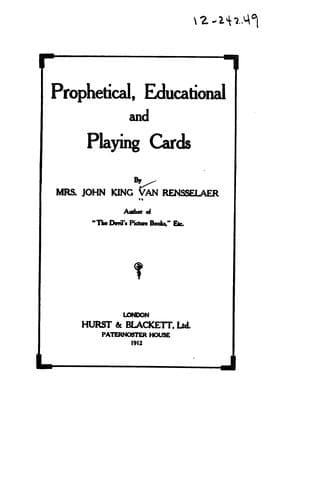
Prophetical, Educational and Playing Cards — John Shaqi
Prophetical, Educational and Playing CardsVan Rensselaer, John King, Mrs.
Religion
Prophetical, Educational and Playing Cards
Van Rensselaer, John King, Mrs.
Fortune-telling by cards -- History; Playing cards -- History
Among uneducated people symbols took the place of written characters in
early days, so, since these knots conveyed a sound and a meaning, a number
is also indicated by the letters of the Hebrew alphabet. These letters or
numbers that were occasionally placed on the early Atouts have the
greatest value when deciphering the attributes found on the Tarots, since
each one has occult significance attached to it, evidently placed there
with the intention of assisting the early fortune-tellers to decipher
their meaning, although omitted in the later books of Thoth-Hermes, when
they were used only for amusement or gambling.
II. LA PAPESSA (THE FEMALE POPE)
This card is supposed to represent Isis. She is typified by a seated
female figure with two pillars behind her, between which hangs a curtain
indicating her temple. She is crowned with a triple tiara, and has an open
book in her lap. This goddess instructs and persuades. Law, erudition, and
occult science are under her protection. As the first female figure among
the Atouts, she represents the priestess of the temple of Thoth, also Eve,
also the mother. When a woman is the inquirer, this card represents her,
instead of the Pagat, which represents a man inquirer. The name of
Papessa, given to this card by the modern Italian card-painter, seems to
be a corruption of Isis. The former name is misleading, and has no
connection with the original meaning of the figure, for it has nothing in
common with the mythical Pope Joan of the Roman Church, while all the
attributes show that the figure represents Isis, or, perhaps, Tashitum,
the consort of Nebo, called "the Interceder." "The Italian card-makers,"
says de Gebelin, "named numbers II and V of the Atouts, mother and father,
or Papessa and Papa;" but he declares "their emblems are Egyptian and the
triple phallus worn by number II is the one borne by Isis in the _Fête des
Pampylies_, where Isis joyfully receives Osiris. It is the symbol of
regeneration of plants, or spring." The card is also supposed to represent
Juno in the Roman mythology. "The attitude connects it," says the same
authority, "with _la haute magic_, since it is the first of the symbols of
the Emerald Tablet, one of the books of Thoth, that was discovered on the
mount of Nebo." Wiltshire says: "Believers in magic find occult meanings
in the hands of this figure." Roman women sacrificed to Juno on their
birthdays, as she was not only the goddess who presided over maternity
(making Mercury her messenger, who carried the child to its parents) but
she was also the protector of women. Part of the great book of Thoth,
called the Ritual of the Dead, said to have been written with the finger
of Thoth, and generally placed with a mummy, says: "I am yesterday.
Yesterday is Osiris. Phthah goes around. The divine Horus prefers Thee.
The god Set does so in turn, as well as Isis, whom thou hast seen." The
Hebrew letter on the second Atout is Beth, which hieroglyphically
Public-domain text, read in full here on John Shaqi.
Reviews
Reviews
No reviews yet
Be the first to share your thoughts on this work.
Join the Discussion
Join the discussion
Sign in to leave a comment or review.
Sign InorCreate an account