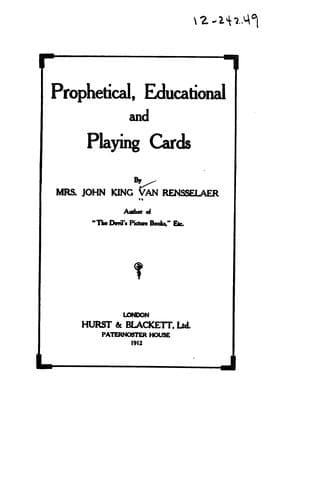
Prophetical, Educational and Playing CardsVan Rensselaer, John King, Mrs.
Religion
Prophetical, Educational and Playing Cards
Van Rensselaer, John King, Mrs.
Fortune-telling by cards -- History; Playing cards -- History
in which it points to the shrine, are considered to have replied to the
inquirer.
The Chariot of the Atouts was, under certain conditions, supposed to
represent Osiris. It was also called "the chariot of Mercury," in the
sense that he was the messenger of Mars when war was to be proclaimed, or
when his caduceus was used as a flag of truce. Seven was always considered
by the Egyptian savants a mystical number, so this card played an
important part in occult science. Count Emiliano di Parravicino, in his
essay published in the _Burlington Magazine_, December, 1903 (page 238),
says: "Mgr. Antonio Dragoni (1814) suggests that the Atouts, numbering
twenty-one [not counting the Joker (_Fou_), which has no number],
represent the Egyptian doctrine beloved by Pythagoras, of the perfect
number Three and the mythical number Seven. Hence, Thoth, the Mercury of
the Egyptians, forms with the pack of pip cards his book or picture of the
creation of three classes of images, which symbolize the first three ages
of the world--_i. e._, the golden, the silver, and the bronze. Each of
these three classes is to represent in its seven divisions a greater
reference or mysticism, a mysterious book of the highest value in the art
of divination, since this book of unbound leaves contained the key to all
mysteries, although its contents were undecipherable to all but those
taught in the temples of Thoth." This proves that other thinkers besides
Papus and de Gebelin had come to the same conclusions from their study of
the Tarot pack, although without having the benefit of exchanging views on
the subject.
The Babylonians believed in seven evil spirits, as the following prayer,
translated from a cuneiform tablet, will prove:
Seven are they. They are seven,
The same in the mighty deep;
And Seven are they in heaven,
'Though in water, sometimes they sleep.
They are neither male, nor female,
These awful spirits that fly,
But like destructive whirlwinds,
They swirl across the sky.
Without a home or offspring,
Compassion and mercy are nil,
Since prayers or supplications,
They neither hear nor feel.
Like wild beasts bred in the mountains,
They defy both gods and men,
Polluting even the fountains
The rivers, the marshes, the fen.
Evil are they, strangely evil,
In temples, in cities, in homes;
For Seven are they, cruel Seven,
With weird and terrible forms.
Public-domain text, read in full here on John Shaqi.
Reviews
Reviews
No reviews yet
Be the first to share your thoughts on this work.
Join the Discussion
Join the discussion
Sign in to leave a comment or review.
Sign InorCreate an account