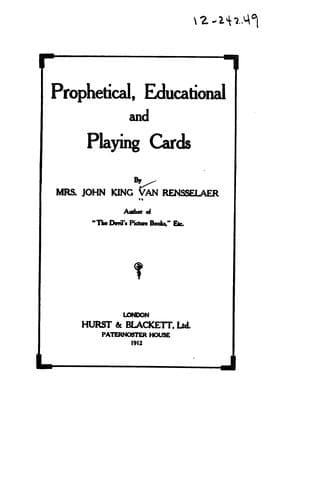
Prophetical, Educational and Playing CardsVan Rensselaer, John King, Mrs.
Religion
Prophetical, Educational and Playing Cards
Van Rensselaer, John King, Mrs.
Fortune-telling by cards -- History; Playing cards -- History
Mr. Willshire, in his "Catalogue of the Playing Cards in the British
Museum," says: "It hardly requires a reference to the Bible to notice the
frequency with which the number Seven is mentioned. Not only was the
Seventh day to be kept holy, but, then, there was the mystery of the Seven
stars, of which Nebo (Mercury) was one, the latter being the most rapid
and brilliant. Also of the Seven golden candlesticks, and, in Zachariah
iii:9, we find that on the stone laid before Joshua there were Seven eyes.
Mercury invented the lyre, according to the Egyptians, in the year of the
world two thousand. At first it had only three strings, but in the hands
of the Muses, Seven were adopted. Then also the Seven virtues were called
the Seven cords of the human lyre, having their analogies in the Seven
colours of the prismatic spectrum. Then there were Seven precious stones,
namely: Carbuncle (garnet), Crystal, Diamond, Agate, Emerald, Sapphire,
and Onyx, besides the Seven chief metals." The emerald was considered the
stone of Thoth, we may infer, since one of his books was entitled "The
Emerald Tablet." Among the Berber tribes, of North Africa, the women put
seven marks on their foreheads, to protect them from the evil eye; this is
also done among some of the Negro tribes. When consulting the pip cards,
the Sevens have peculiar and occult values, marking the boundaries between
those lower and higher. They also make combinations that influence the
consideration of other cards.
VIII. LA GIUSTIZIA (Justice)
Public-domain text, read in full here on John Shaqi.
Reviews
Reviews
No reviews yet
Be the first to share your thoughts on this work.
Join the Discussion
Join the discussion
Sign in to leave a comment or review.
Sign InorCreate an account