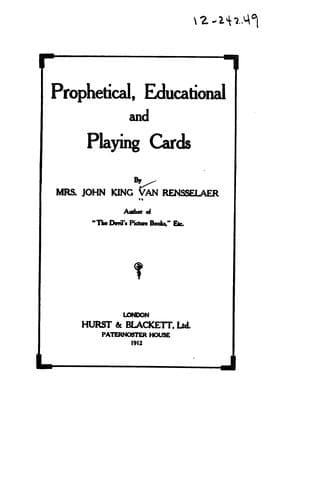
Prophetical, Educational and Playing Cards — John Shaqi
Prophetical, Educational and Playing CardsVan Rensselaer, John King, Mrs.
Religion
Prophetical, Educational and Playing Cards
Van Rensselaer, John King, Mrs.
Fortune-telling by cards -- History; Playing cards -- History
It therefore followed that the history and traditions peculiar to the
ceremonies connected with that personage should be studied in order to
trace Playing Cards to their birthplace and find for them an origin,
without weakly stopping at the fourteenth century, and declaring that
cards came out of space, as many authors have done.
The heraldic devices of Mercury, which are the emblems of what has always
been called, by historians, "The Book of Thoth Hermes Trismegistus," are
in themselves mute proof of the connection of the Tarots (as they are now
called) with the cult of Mercury. These cards are the oldest ones known,
and the symbols are retained in Italian Tarots of to-day, so it may be
allowed that when Playing Cards are studied as the leaves of the book of a
cult, not as a game, their own pictures relate the story that has lain
dormant for many hundreds of years. They only required to have a key in
order to be intelligible to any one interested in the subject, and this
has been furnished by recognizing the four attributes of Mercury in the
card pips, which had escaped the notice of students until the present
time, as well as the attributes of the picture part of the pack called the
Atouts, which are those of Egyptian gods.
The popular notion that cards were invented for the amusement of a crazy
French king is quite disproved by the historical records of the Tarots of
the fourteenth century and the packs that survive. There are some
beautiful specimens in Mr. Pierpont Morgan's collection, the emblems and
devices of which are identical with records of the ancient Tarots, and
these cards are very much older than the French packs.
Although the gap between the old cards and the worship of Mercury in
Etruria is still to be bridged through accurate historical data, the
inferential connection is too strong to be ignored and the rules of the
games played with the cards intended for prophesying or fortune-telling,
as well as the tradition connected with the Tarots themselves offer
connecting links with the cult of Mercury that cannot afford to be
disregarded, as has been done hitherto.
Mr. Stuart Culin, in his introduction to "Korean Games," says:
"Investigation has been hitherto comparatively unproductive of results
from the fact that most students have failed to perceive the true
significance of games in primitive culture, regarding them primarily as
pastimes." But he traces many of the games which are common to all
children all over the world to a "sacred and divinatory origin, a theory
that finds confirmation in their traditional associations, such as the use
of cards in fortune-telling."
Public-domain text, read in full here on John Shaqi.
Reviews
Reviews
No reviews yet
Be the first to share your thoughts on this work.
Join the Discussion
Join the discussion
Sign in to leave a comment or review.
Sign InorCreate an account