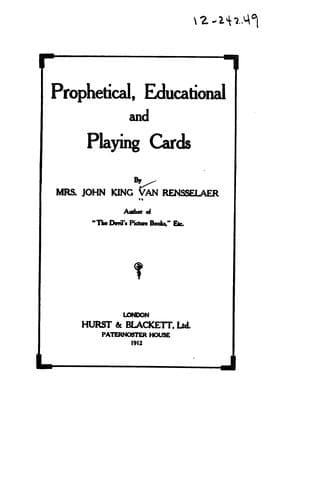
Prophetical, Educational and Playing CardsVan Rensselaer, John King, Mrs.
Religion
Prophetical, Educational and Playing Cards
Van Rensselaer, John King, Mrs.
Fortune-telling by cards -- History; Playing cards -- History
That Playing Cards are derived from the mysteries of ancient days will
prove to be such a novel idea to many persons that the well-worn
expression: "It can't be true, I never heard it before," will be hurled at
the author. But such critics are begged to pause, to consider the subject
carefully, and to marshal convincing proofs to the contrary before dipping
caustic-tipped pens into the inkwells of ignorance, doubt and disbelief.
Court de Gebelin, over a hundred years ago, was scoffed at and called a
dreamer by the writers who followed him and wrote on the subject of
Playing Cards; yet these same gentlemen with strange accord, while failing
to advance any proofs of de Gebelin's inconsistencies or ignorant
deductions, contradicted themselves by agreeing with his bold statement
that the Tarots were the survival of the cult of Mercury or Thoth Hermes.
The nineteen-hundred-year-old crusade against cards, as wicked tools of
wicked persons, dates from the struggle of the early Christians against
idolatry, and this has been transmitted for generations, although there
are few persons who can trace their prejudices to the true origin. Nor do
they realize how often Divine commands to consult the occult were laid
upon the Israelites without carefully perusing the books of Moses.
It may be as well to sum up in a few words the various proofs that the
Playing Cards we now use are descended from the ancient mysteries. First,
Arrows, and their successors, Straws, Sceptres or Rods. Cups, Swords and
Money have always been used in connection with prophesying. Second, the
emblems of Swords, Sceptres (or Stylus), Cups and Money have always
represented Mercury, Thoth and Nebo as their emblems or attributes. Third,
the worship of Thoth was introduced into Italy by the priests of that
cult, as is proved historically by the remains of their Temple at
Puozzoli, as well as the Temple there to Mercury, near which place the
Tarots are still found in common use in their original form, displaying
pictures of the Egyptian deities. Fourth, the Egyptians or Gypsies are
the fortune-tellers of Europe and always use cards for the purpose. Fifth,
the name given originally to the Tarots or prophetical cards that bear the
ancient emblems was Nabi, Naypes or "Prophets," which name is retained for
playing cards in many parts of the world.
Thanks are due to the custodians of various museums who have displayed
their collection of cards, and in particular to the artist, Mr. Burton
Donnel Hughes, who kindly and skillfully designed the beautifully symbolic
cover for this book.
M. K. VAN RENSSELAER.
_New York, 1912._
CHAPTER I
PROPHETICAL AND OTHER CARDS
Public-domain text, read in full here on John Shaqi.
Reviews
Reviews
No reviews yet
Be the first to share your thoughts on this work.
Join the Discussion
Join the discussion
Sign in to leave a comment or review.
Sign InorCreate an account