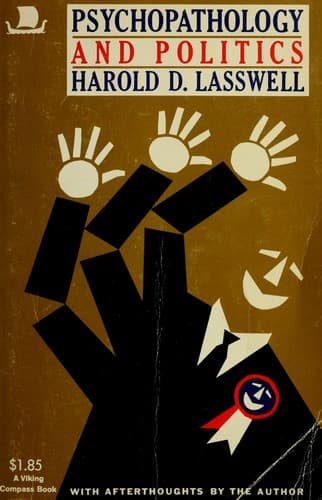
Psychopathology and politicsLasswell, Harold D. (Harold Dwight)
Science
Psychopathology and politics
Lasswell, Harold D. (Harold Dwight)
Personality and politics; Political science; Psychoanalysis; Psychology, Pathological
Why the peaceful Viennese should suddenly be transformed
temporarily into mad beasts is also clear to the psychoanalysts.
Had the police offered no resistance the crowd would soon have
dispersed and no harm would have been done. But once the police
fired blood flowed and the mob reacted savagely, responding to
the ancient fear of castration by the father which is present in
all of us unconsciously in the face of the punishing authority.
Therefore, fear grew along with the violence, each increase leading
to new violence and greater fear, as appeasement can only follow a
complete outbreak and as the inhabitants were widely scattered in
their houses it took three days before the last hatred could fully
get out.
One further point can only be explained by psychoanalysis. The
social democratic leaders are at heart revolutionary, but they
did not wish this demonstration. They realized that revolution in
little Austria today would be suicidal, and, therefore, at a given
moment called out the republican guard with orders to interfere and
prevent violence. The guard arrived much too late.
Why did not the leaders send out the guard at 6 a.m. when they knew
the demonstration was beginning? They say they “forgot.” This is
_a flagrant_ example of unconscious forgetfulness. The socialists
forgot to take the only step which could have prevented something
which they consciously disapproved, but unconsciously desired.
The Vienna riots were in the deepest sense a family row.[51]
Eder speculates about the unconscious factors in the well-known
tendency of certain political alternatives to succeed one another in
crude pendulum fashion.
I think it was Mr. Zangwill who once said that it is a principle
of the British Constitution that the King can do no wrong and his
ministers no right. That is to say, the ambivalency originally
experienced toward the father is now split; the sentiment of
disloyalty, etc., is displaced on to the King’s ministers, or
on to some of them, or on to the opposition.... Modern society
has discovered the principle of election, and the vote to
give expression to the hostile feelings toward their rulers.
Psychoanalytically an election may be regarded as the sublimation
of regicide (primary parricide) with the object of placing oneself
on the throne; the vote is like a repeating decimal; the father
is killed but never dies. The ministers are our substitutes for
ourselves. Hence the political maxim of the swing of the pendulum.
Public-domain text, read in full here on John Shaqi.
Reviews
Reviews
No reviews yet
Be the first to share your thoughts on this work.
Elsewhere in the archive
Join the Discussion
Join the discussion
Sign in to leave a comment or review.
Sign InorCreate an account