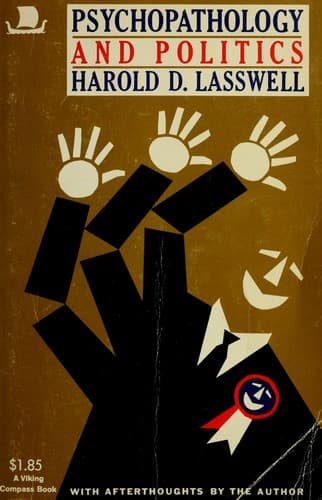
Psychopathology and politicsLasswell, Harold D. (Harold Dwight)
Science
Psychopathology and politics
Lasswell, Harold D. (Harold Dwight)
Personality and politics; Political science; Psychoanalysis; Psychology, Pathological
Alexander and Staub have undertaken to explain the unconscious basis
of the crisis which is produced in the community when criminals are
permitted to go with no punishment or with light punishment. The study
of personality genesis shows that the sublimation of primitive impulses
is possible on the basis of a kind of primitive “social contract.” The
individual foregoes direct indulgences (which have the disadvantage
of bringing him into conflict with authority), and substitutes more
complex patterns of behavior on the tacit understanding that love and
safety will thereby be insured. When another individual breaks over
and gratifies his illicit impulses directly on a primitive level, the
equilibrium of every personality is threatened. The conscious self
perceives that it is possible to “get by,” and this threatens the
whole structure of sublimation. The superego tries to maintain order
by directing energy against the ego, perhaps subjecting it to “pricks
of conscience,” for so much as entertaining the possibility of illicit
gratification, and seeks to turn the ego toward activities which reduce
temptation. This may involve the reconstruction of the environment
by seeking to eliminate the “non-ideal” elements in it, and may be
exemplified in the panicky demand for the annihilation of the outsider
(who is a criminal) for the sake of keeping the chains on the insider
(who is a criminal). Every criminal is a threat to the whole social
order since he reinstates with more or less success an acute conflict
within the lives of all members of society. The success of the superego
depends upon imposing certain ways of interpreting reality upon the
self. When reality grossly refuses to conform to the “ideal,” the
energies of the self are divided, and an acute crisis supervenes. The
superego undertakes to reinforce its side of the contradictory ego
trends by punishing the ego, and by forcing the projection of this
situation upon the outer world. Certain aspects of the outer world
become “bad” because they are connected in private experience with the
pangs inflicted by the taskmaster within, the conscience. A strong
conscience may enforce this “distortion” of reality upon the self
to such a degree that the self acts on quite fantastic assumptions
about reality. These are most acutely manifested in such phenomena as
confusion states, hallucinations, and delusions, all of which are forms
of deformed reality. When reality becomes “ominous,” violent efforts to
change may appear futile, and safety is sought in physical flight, or
in physical passivity and autistic preoccupation. Since our conceptions
of reality are based upon little “first-hand” experience of the world
about us, the superego usually has a rather easy time of it.
Public-domain text, read in full here on John Shaqi.
Reviews
Reviews
No reviews yet
Be the first to share your thoughts on this work.
Elsewhere in the archive
Join the Discussion
Join the discussion
Sign in to leave a comment or review.
Sign InorCreate an account