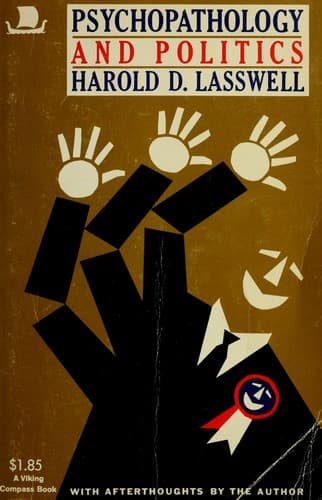
Psychopathology and politicsLasswell, Harold D. (Harold Dwight)
Science
Psychopathology and politics
Lasswell, Harold D. (Harold Dwight)
Personality and politics; Political science; Psychoanalysis; Psychology, Pathological
The mere fact that motives are more or less universal does not
mean that they are always activated with the same intensity. They
may block one another, until some exciting condition disturbs the
adjustment and releases stores of energy. Indeed, the exploration of
unconscious motivation lays the basis for the understanding of the
well-known disproportionality between responses and immediate stimuli,
a disproportionality which has been the subject of much puzzled and
satiric comment. Farmers do vote against the Republicans when the crops
fail through adverse weather conditions, although reflection would tend
to minimize the possibility that the party in power exercises much
authority over the weather. Oversights in personal relations which seem
very slight do actually give rise to huge affective reactions. The clue
to the magnitude of this notorious disproportionality is to be found
in the nature of the deeper (earlier) psychological structures of the
individual. By the intensive analysis of representative people, it is
possible to obtain clues to the nature of these “unseen forces,” and to
devise ways and means of dealing with them for the accomplishment of
social purposes.
Modern democratic society is accustomed to the settlement of
differences in discussion and in voting. This is a special form of
politics, for differences may also be settled with a minimum of
discussion and a maximum of coercion. In its modern manifestation,
democracy and representative government have enthroned “government by
discussion,” that is, “government by public opinion.” President Lowell
some time ago pointed out that public opinion could only be said to
exist where constitutional principles were agreed upon. Differences
must be treated as defined within an area of agreement. Democratic
and representative institutions presuppose the existence of the
public which is made up of all those who follow affairs and expect to
determine policy in discussion and by measures short of coercion. The
public has a common focus of attention, a consensus on constitutional
principles, and a zone of tolerance for conflicting demands respecting
social policy.
When debate is admissible, some standards of right are tacitly admitted
to be uncertain. The zone of the debatable is not fixed and immutable,
but flexible and shifting. Questions rise and debate proceeds; and
presently the resulting solution is no longer discussible. It has
become sanctified by all the sentiments which buttress the moral order,
and any challenge is met by the unanimous and spontaneous action of the
community in its defense. In the presence of a challenge, the public
may be dissolved into a crowd, by which is meant a group whose members
are emotionally aroused and intolerant of dissent.
Public-domain text, read in full here on John Shaqi.
Reviews
Reviews
No reviews yet
Be the first to share your thoughts on this work.
Elsewhere in the archive
Join the Discussion
Join the discussion
Sign in to leave a comment or review.
Sign InorCreate an account